 By Robert AlexanderShareNewsweek is a Trust Project member
The catastrophic crash of a UPS MD-11 cargo jet in Louisville, Kentucky, on November 4 has prompted searching questions about aging aircraft, maintenance practices and whether the aviation industry continues to repeat failures identified decades ago.
Among those cautious but deeply concerned is Robert A. Clifford, founder of Clifford Law Offices and one of the nation’s most experienced aviation attorneys, who told Newsweek in an exclusive interview that early indicators point to a “catastrophic failure” with striking historical parallels.
Why It Matters
The Louisville disaster is more than a tragic cargo-plane crash; it exposes long-standing vulnerabilities in how aging aircraft are inspected, certified and returned to service.
Early evidence and expert analysis suggest the MD-11’s catastrophic engine-pylon separation may reflect broader industry practices that extend component life spans and stretch inspection intervals—decisions veteran aviation attorney Robert A. Clifford says can put “profits before safety.”
At the same time, the wreckage carved through a working-class neighborhood, killing 14 people and upending local businesses that “live day-to-day,” underscoring the profound human cost when these systems fail.
As investigators probe whether maintenance, metallurgy or storage protocols played a role, the crash raises national questions about oversight, accountability and whether aviation has truly learned from past warnings.
 ...
...What To Know
A Catastrophic Failure Seconds After Takeoff
UPS Flight 2976 crashed shortly after takeoff from Louisville Muhammad Ali International Airport, killing the three crew members and 11 people on the ground and injuring more than 20 others.
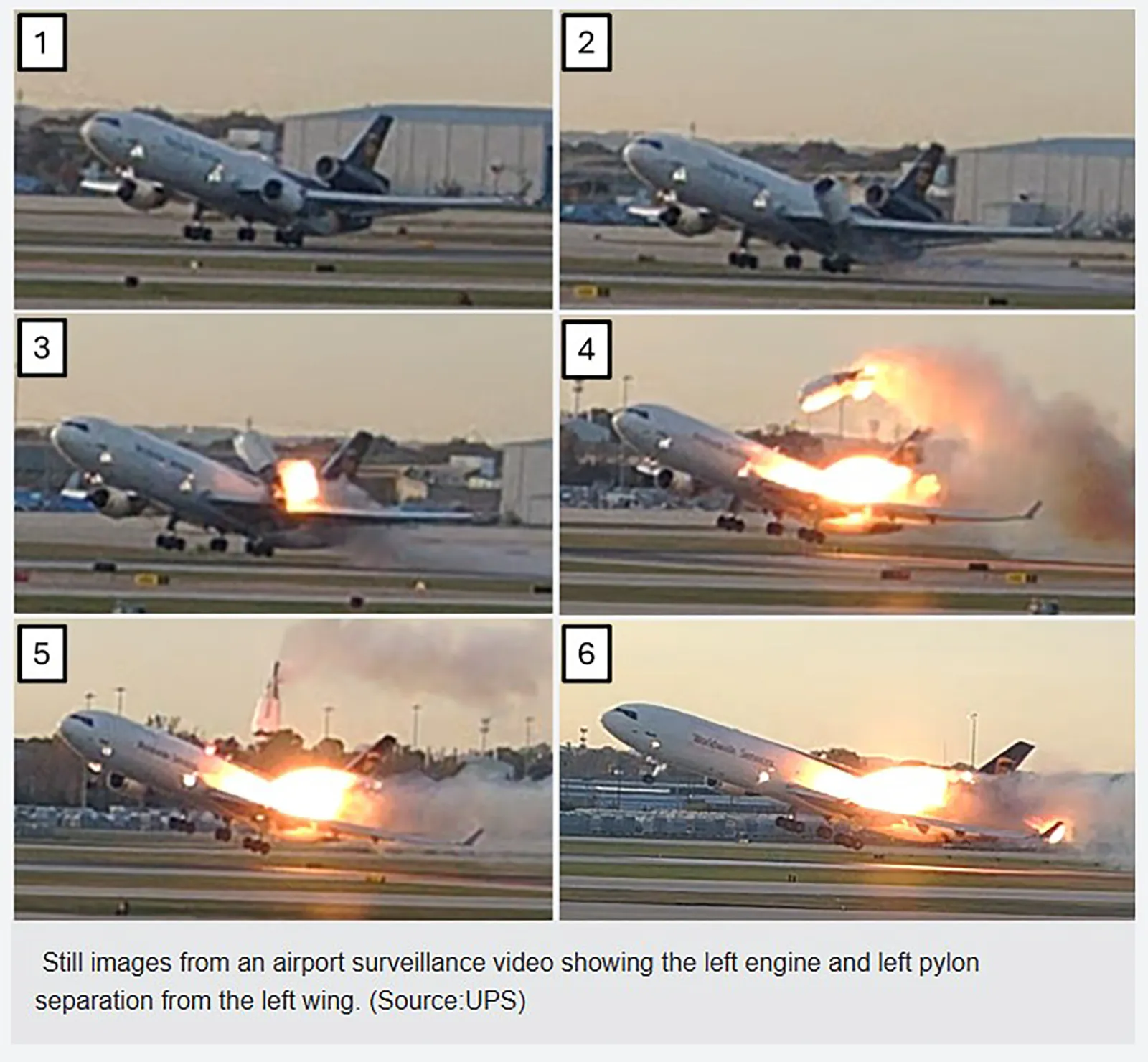
According to the National Transportation Safety Board’s (NTSB) preliminary report, airport surveillance video showed the left engine (No. 1) and its pylon separating from the wing seconds after rotation, followed by an intense fire that continued until the aircraft hit surrounding buildings.
The accident aircraft—a McDonnell Douglas MD-11 built in 1991—was originally delivered as an MD-2 to Thai Airways International under the registration HS-TME.
It was acquired by UPS in 2006, assigned the new U.S. registration N259UP and subsequently converted to an MD-11F freighter—and had amassed 92,992 flight hours and 21,043 cycles at the time of the crash, following decades of service and a recent period of long-term storage and heavy maintenance in Arizona and Texas before its return to operation.
Last Inspections and Outstanding SDI Tasks
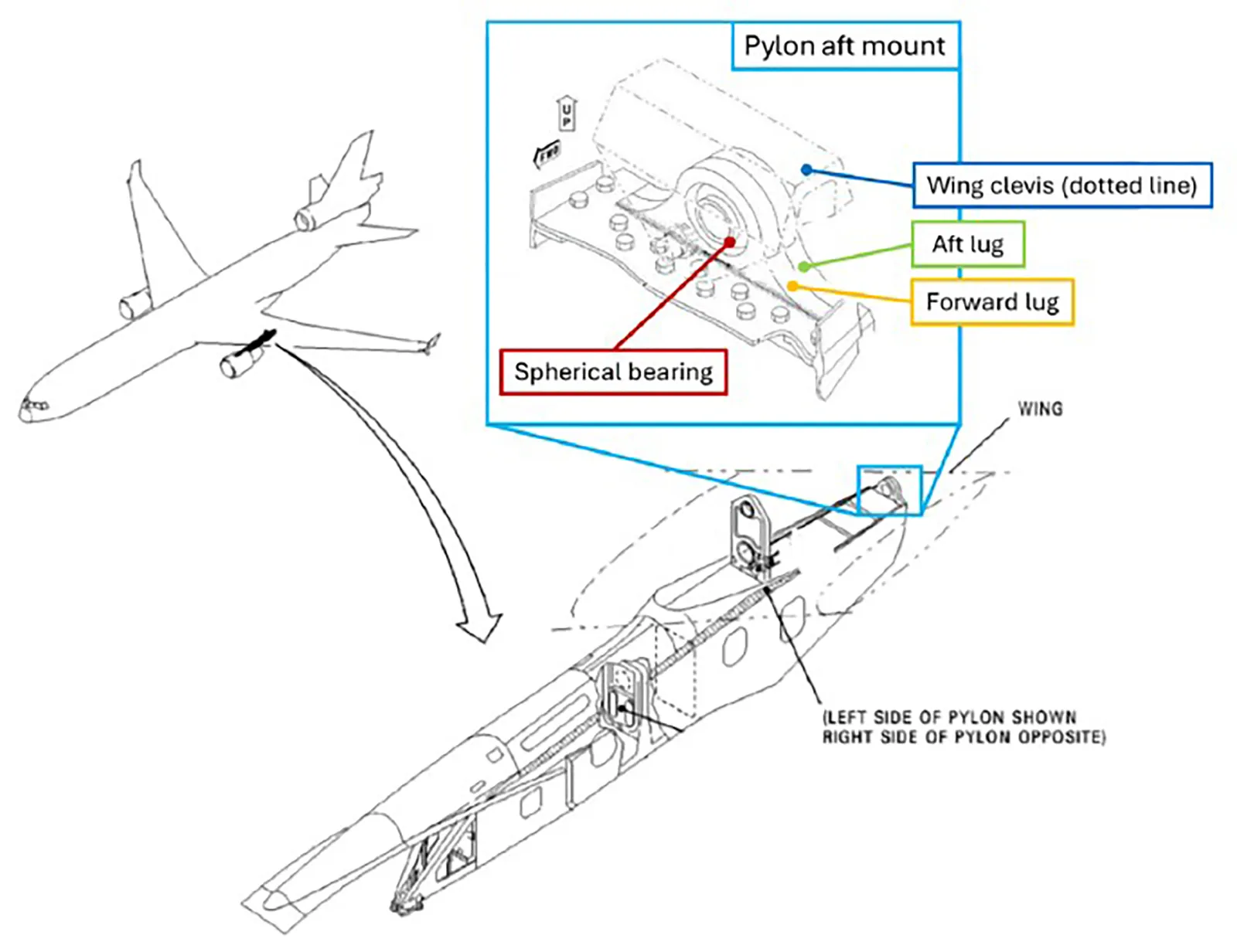
According to the NTSB, the MD-11’s left pylon aft mount had last undergone its required general visual inspection (GVI) and detailed visual inspection on October 28, 2021, as part of UPS’ 72-month maintenance interval.
A separate 24-month/4,800-hour lubrication task on the pylon’s thrust links and spherical bearings was most recently completed on October 18, 2025, just weeks before the crash.
However, the NTSB found that two critical Special Detailed Inspections (SDIs)—one of the left pylon aft mount lugs, due at 29,200 cycles, and another of the left wing clevis support, due at 28,000 cycles—had not yet been performed.
At the time of the accident, the aircraft had accumulated 21,043 cycles, meaning both SDIs were still outstanding.
 ...
...Echoes of 1979: Clifford’s First Case and the Parallels
Robert A. Clifford, founder of Clifford Law Offices, spoke exclusively with Newsweek about the disaster.
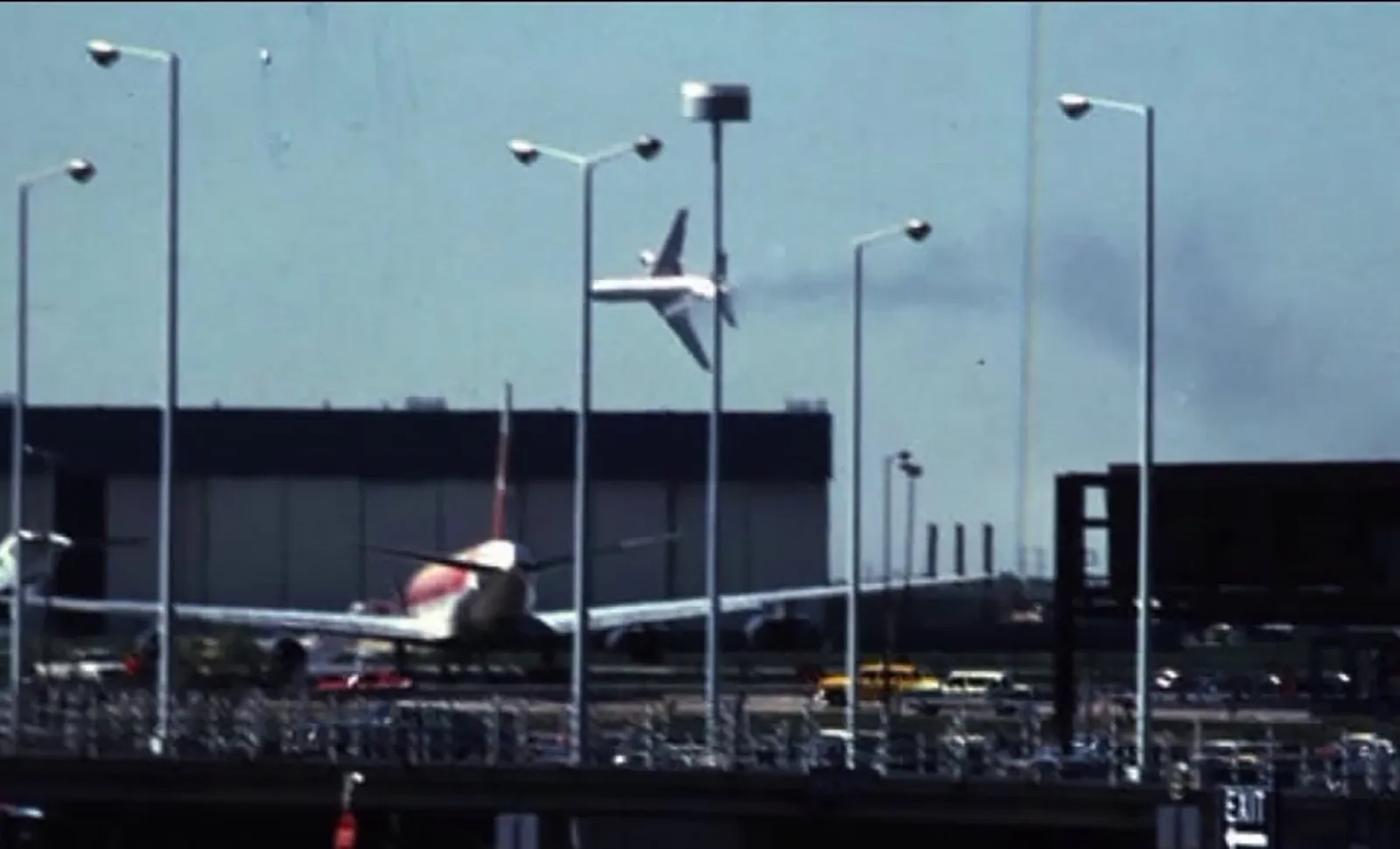
Clifford’s first aviation case was the 1979 crash of American Airlines Flight 191 in Chicago, a disaster caused by the left engine (No. 1) and pylon separating from the DC-10’s wing shortly after takeoff.
The attorney said the Louisville crash initially appeared to mirror that event.
“The report reveals a very strong similarity between the crash in Louisville and the May 1979 DC-10 crash of American Airlines Flight 191 in Chicago killing 271 souls aboard,” he noted.
But Clifford emphasized that the parallels end with the basic sequence of engine separation and loss of control.
As he explained, the McDonnell Douglas jet involved in the Louisville crash was more than three decades old and had been returned to service after extensive maintenance, raising different technical questions than those that defined Flight 191.
“What is new about this case is that the age of the aircraft suggests that this plane was old, tired, and well beyond its useful life…certainly triggering questions about profit over safety,” he said.
 ...
...And unlike Flight 191—which was only 7 years old when it crashed, having logged just under 20,000 hours—the Louisville case does not appear linked to the kind of improper maintenance that doomed the DC-10.
Flight 191’s pylon failure stemmed from a flawed procedure in which mechanics removed and reinstalled the engine and pylon as a single unit using a forklift, an improvised method that caused hidden structural damage.
Clifford explained that the 1979 disaster occurred “because a forklift hit the engine during service and caused a fracture of the pylon.”
In Louisville, by contrast, early findings point to fatigue fractures in bolts and locking devices on a 34-year-old aircraft, raising very different technical questions for investigators.
“Metal fatigue can happen over time and should be detected upon proper safety investigations and inspections,” Clifford said, adding that failure to detect those fractures “could easily be the reason why there was an ultimate failure of the pylon used to attach the engine to the wing.”
“In the Louisville crash, based on the available information, including videos, there was obviously a catastrophic failure during takeoff that led to this horrific in-flight fire, the subsequent crash, and the numerous flight crew and ground victims’ deaths that resulted from it,” Clifford said in earlier remarks to the media, later expanded upon in his interview.
 ...
...Aging Aircraft, Maintenance Questions and ‘Profit Over Safety
Speaking with Newsweek, he emphasized that component life cycles and maintenance oversight will likely be central to the investigation.
Aircraft parts are manufactured with an expected service life, he explained, but those limits are often extended over time—sometimes, he suggested, for economic reasons rather than safety.
“Let’s say that this pylon…has a 20-year life expectancy,” Clifford said. “What happens is that 15 years out, they look at it again and they say, ‘Wow, the fatigue on this is not nearly what we thought it would be. We’re going to extend the life expectancy to 25 years, 28 years.’ And now comes 20 years and they take another look and they say, ‘Holy cow, this thing is doing so well, we’re going to extend the life expectancy to 35 years.’”
From Clifford’s perspective, this pattern—extend, reassess, extend again—may save operators money but can create long-term risks.
“It’s profits before safety,” he said, noting that longer intervals also reduce the number of detailed inspections performed on critical load-bearing components.
Clifford also underscored that inspection methods themselves vary significantly in cost and rigor. “There are various forms of inspection. There are observations. There are ultrasound. There are immersion inspections. There’s all sorts of different kinds. And they always seem to take the cheapest route.”
The MD-11 involved, according to what Clifford has been told, had been stored in the desert before being reintroduced into UPS’ fleet—a practice that is not inherently unsafe but one that requires thorough refurbishment and inspection.
“You’ve got a 35-year-old aircraft that was taken out of mothballs from Arizona. It was put back into service and inspected by some folks in Arizona, we understand,” Clifford noted.
He added that several entities may ultimately share responsibility: “You have Boeing involved. You have General Electric involved. You have UPS involved. And all of these folks have responsibility for what happened in this terrible crash.”
A Community Devastated and an Investigation Just Beginning
Clifford visited Louisville shortly after the disaster at the request of families and local businesses. “I’ve been retained by several families and some businesses to advance litigation to recover from their losses of the family members as well as business interruption and losses,” he said.
He described the affected area—home to auto shops, small manufacturers and a petroleum recycling facility—as a close-knit, working-class community now facing an overwhelming recovery effort.
Families he met, he said, “live day-to-day” and are grappling not only with tragedy but with the economic shock that followed the crash.
Clifford stressed that investigations must determine whether the failure stemmed from aging components, maintenance practices, storage and reactivation procedures or a combination of factors.
“To me, this is going to come down to a maintenance case,” he said, while noting that metallurgy—the science of material fatigue and fracturing—will likely “play a central role” in determining precisely why the engine and pylon separated.
Whatever the NTSB ultimately finds, Clifford said, the industry must confront the recurring themes that have emerged across decades of major accidents. “The aviation industry needs to learn not to repeat its mistakes,” he said in earlier public comments.
For now, the investigation continues. UPS has grounded its MD-11 fleet pending further findings, and federal investigators are analyzing flight-data recordings, maintenance logs and recovered components.
Clifford Law Offices has been retained by a Louisville family who lost a loved one in the UPS cargo jet crash and has been contacted by several others affected by the tragedy.
Robert Clifford stated: "Families who lost loved ones in this crash deserve the truth and full accountability. Clifford Law Offices has begun a thorough investigation to ensure those responsible face the consequences of their preventable failures."
But for Clifford, the central questions remain clear: whether critical parts were allowed to remain in service “beyond maybe what they should,” and whether the systems designed to prevent such a failure functioned as they should have.
“It’s very sad,” he said. “There’s so much to talk about here.”
 ...
...Flight Crew
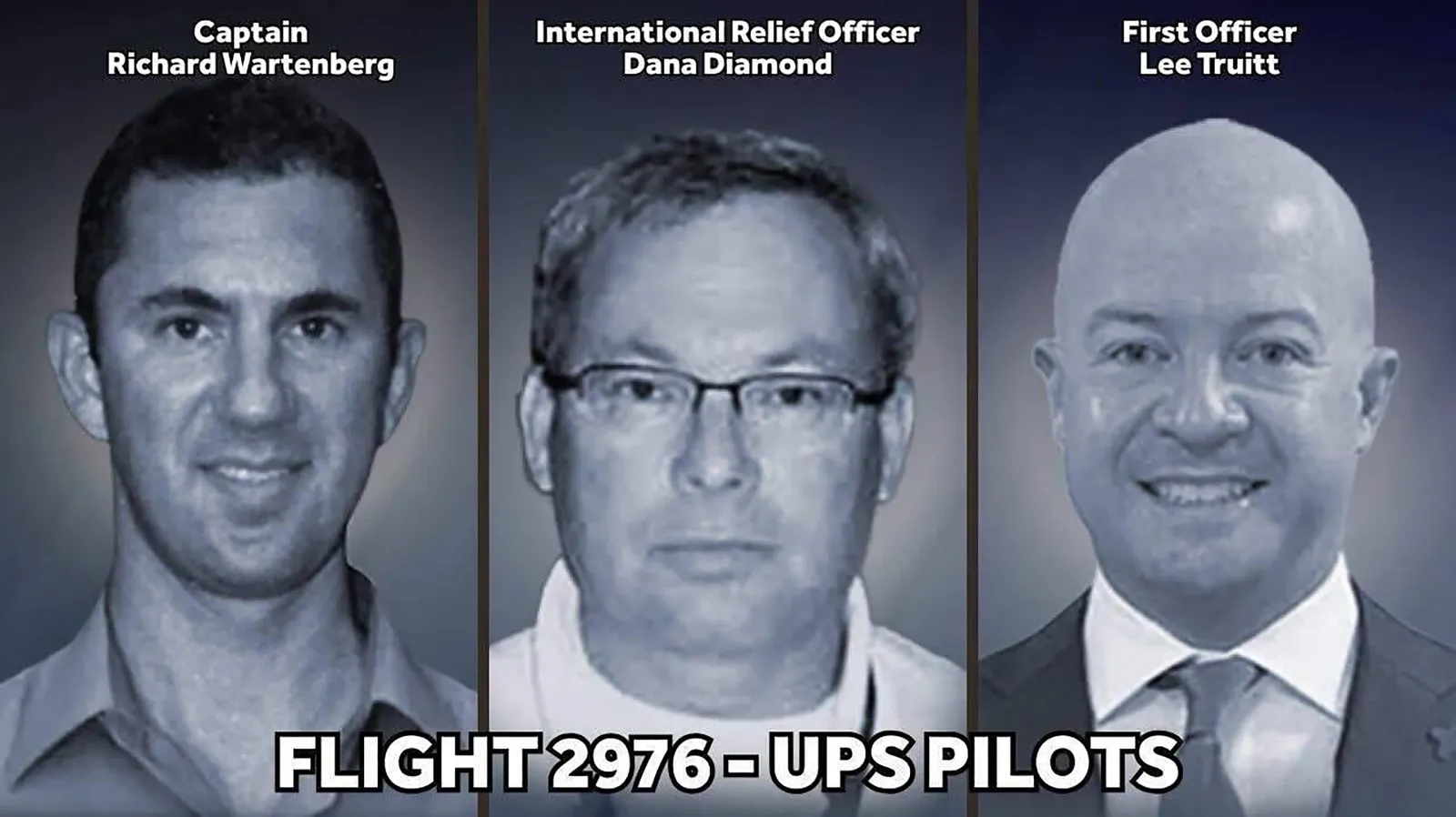
- Captain and International Relief Officer Dana Diamond, 62—A senior UPS captain and one of the three crew members operating Flight 2976.
- Captain Richard Wartenberg, 57—A veteran UPS pilot identified by the company as one of the crew members lost.
- First Officer Lee Truitt, 45—The first officer on board the aircraft at the time of the crash.
Ground Victims
- Angela Anderson, 45—A local resident killed when the aircraft impacted nearby industrial buildings.
- Carlos Fernandez, 52—Identified by the coroner among those fatally injured on the ground.
- Louisnes Fedon, 47—A grandfather killed in the impact area.
- Kimberly Asa, 3—The youngest victim, identified as the granddaughter of Louisnes Fedon.
- Trinadette “Trina” Chavez, 37—A woman killed in the industrial zone struck by the aircraft.
- Tony Crain, 65—One of the community members who died at the scene.
- John Loucks, 52—Identified by the coroner as among the victims near the crash corridor.
- John Spray Jr., 45—Another individual fatally injured in the affected industrial area.
- Matthew Sweets, 37—A ground victim listed among those killed when the aircraft impacted multiple structures.
- Ella Petty Whorton, 31—Identified as one of the 14 people who died as a result of the crash.
- Megan Washburn, 35—Among the fatalities located and identified after extensive search and recovery work.
What People Are Saying
Clifford told Newsweek: “In the Louisville crash, based on the available information, including videos, there was obviously a catastrophic failure during takeoff that led to this horrific in-flight fire, the subsequent crash, and the numerous flight crew and ground victims' deaths that resulted from it.”
Jeff Guzzetti, investigator speaking to the similarities between this crash and that of Flight 191 in 1979, said: “The circumstances are very similar, but the root cause of the engine separation appears to be different.”
What Happens Next
The NTSB will now move from initial fact-gathering into a detailed technical investigation, analyzing fractured metal from the separated engine pylon, reviewing maintenance and storage records from the aircraft’s return to service in Arizona and interviewing UPS personnel and third-party mechanics to determine whether age, fatigue or procedural lapses caused the failure.
UPS’ MD-11 fleet remains grounded while regulators assess whether broader inspections or directives are needed.
In parallel, civil litigation will accelerate, with families and affected businesses pursuing claims and attorneys like Clifford preparing cases.
A final NTSB report—likely a year or more away—will establish the crash’s probable cause and shape any regulatory, safety or industry reforms that follow.
Request Reprint & LicensingSubmit CorrectionView Editorial & AI Guidelines Add Newsweek as a preferred source on Google to see more of our trusted coverage when you search.
Recommended For You
 NewsWho Is Bruna Ferreira? Mother Of Karoline Leavitt’s Nephew Arrested By ICE2 min read
 U.S.Kroger Recall Update: Full List of Product Warnings Across 18 States7 min read
 U.S.Kristi Noem Among Those Named in Judge’s Criminal Inquiry: Full List2 min read
 NewsFDA Scraps Plans to Test Cosmetics For Asbestos1 min read
 U.S.Donald Trump’s Attempted Assassin Invites Him To ‘Punch Him in the Face’1 min read
 NewsThousands Advised To Remain Indoors In Oregon, California3 min read
Related Podcasts
Top Stories
 WorldPutin Gives Update on Ukraine Peace, Trump Sending Witkoff to Moscow: Live Updates3 min read
 NewsUncommon Knowledge: Don’t Blame Trump for the Gerrymander Paradox8 min read
 NewsDC Shooting Live Updates: National Guard Members Shot Near White House, Suspect in Custody2 min read
 Live BlogThanksgiving Winter Storm Live Tracker, 2,000 Flights Delayed, Up To 3ft Of Snow Expected1 min read
 NewsDonald Trump Reacts to National Guard Shooting4 min read
 NewsGoFundMe for Mother of Karoline Leavitt’s Nephew Detained by ICE Nears Goal3 min read
Trending
 MoneyNew ‘Cash Law’ Could Change Grocery Store Rules3 min read
 U.S. Economy‘Mass Blackout’ Starts Today: What to Know3 min read
 Home PricesPrice Correction ‘Worse Than 2008’ Coming To US Housing Market—Analyst5 min read
 SnowfallWinter Storm Warning Issued As 25 Inches of Snow To Strike5 min read
 WeatherWinter Storm Warning As 20 Inches of Snow To Hit: ‘Life-Threatening’4 min read
Opinion
 OpinionINTERPOL Must Not Elect One of Its Chief Abusers As Its Next President | Opinion4 min read
 OpinionThanksgiving in America | Opinion5 min read
 OpinionWhen Strength Becomes a Burden—Reimagining the Strong Black Woman | Opinion4 min read
 OpinionConventional Wisdom: Trump Turkey Pardoning Edition3 min read
