- Home
Edition
Africa Australia Brasil Canada Canada (français) España Europe France Global Indonesia New Zealand United Kingdom United States Edition:
Global
Edition:
Global
- Africa
- Australia
- Brasil
- Canada
- Canada (français)
- España
- Europe
- France
- Indonesia
- New Zealand
- United Kingdom
- United States
Academic rigour, journalistic flair
 The disability rate for people aged 15 years and over in Canada was 27 per cent in 2022.
(Unsplash+/Annie Spratt)
Disability rights and services are shaped by the narratives embedded in policies like the Accessible Canada Act and MAID
Published: December 3, 2025 1.56pm GMT
Alfiya Battalova, Royal Roads University
The disability rate for people aged 15 years and over in Canada was 27 per cent in 2022.
(Unsplash+/Annie Spratt)
Disability rights and services are shaped by the narratives embedded in policies like the Accessible Canada Act and MAID
Published: December 3, 2025 1.56pm GMT
Alfiya Battalova, Royal Roads University
Author
-
 Alfiya Battalova
Assistant Professor in Justice Studies, Royal Roads University
Disclosure statement
Alfiya Battalova does not work for, consult, own shares in or receive funding from any company or organisation that would benefit from this article, and has disclosed no relevant affiliations beyond their academic appointment.
Partners

Royal Roads University provides funding as a member of The Conversation CA.
Royal Roads University provides funding as a member of The Conversation CA-FR.
View all partners
DOI
https://doi.org/10.64628/AAM.4e9uc37q3
https://theconversation.com/disability-rights-and-services-are-shaped-by-the-narratives-embedded-in-policies-like-the-accessible-canada-act-and-maid-271094 https://theconversation.com/disability-rights-and-services-are-shaped-by-the-narratives-embedded-in-policies-like-the-accessible-canada-act-and-maid-271094 Link copied Share articleShare article
Copy link Email Bluesky Facebook WhatsApp Messenger LinkedIn X (Twitter)Print article
This year’s International Day of Persons with Disabilities centres on “fostering disability inclusive societies for advancing social progress.”
The theme recognizes persistent barriers faced by disabled people: disproportionate poverty, employment discrimination, inadequate social protection and the denial of dignity and autonomy in care systems.
Accessibility gains and losses
In 2022, the disability rate for people aged 15 years and over in Canada was 27 per cent. Nearly eight million people identified as having one or more disabilities, an increase of 1.7 million people over 2017, when the disability rate was 22 per cent.
The United Nations’ latest review of Canada’s implementation of the UN Convention on the Rights of Persons with Disabilities praised Canada’s progress in adopting the Accessible Canada Act and accessibility legislation at the provincial/territorial levels.
At the same time, the committee identified several areas of deep concern, such as the expansion of Medical Assistance in Dying (MAID) for disabled people whose death is not foreseeable. The report warns that inadequate supports risk normalizing death as a “solution” to poverty, lack of services and discrimination, and that the concept of choice can create a false dichotomy, enabling death without guaranteeing support.
All policies tell stories
All policies convey narratives and stories that carry values. They deal with questions of “why” as well as “how.”
Narratives distil and reflect a particular understanding of social and political relations. A story about disability as a phenomenon can be told from different perspectives. A medical model of disability views disability as a personal problem, a social model focuses on removing the barriers, and a human rights model introduces a language of rights and their protection. We often hear deficit-based stories rooted in the medical model about disability.
The Accessible Canada Act (ACA) and Medical Assistance in Dying (MAID) Track 2 in Canada tell contradictory stories about disability rights and state responsibility.
 The Accessible Canada Act is framed as a landmark piece of human rights legislation, emphasizing inclusion, accessibility and the removal of barriers.
(Pixabay)
The Accessible Canada Act is framed as a landmark piece of human rights legislation, emphasizing inclusion, accessibility and the removal of barriers.
(Pixabay)
The ACA is framed as a landmark piece of human rights legislation, emphasizing inclusion, accessibility and the removal of barriers to ensure full participation for people with disabilities, with a vision of a barrier-free Canada by 2040. Disability activists played a central role in its development, and the law is celebrated for its systemic, proactive approach to tackling exclusion and discrimination, offering rights to consultation, representation and accessible information.
In contrast, the MAID regime, especially after the expansion through Bill C-7, has been criticized for normalizing assisted death as a response to suffering caused by lack of access to medical, disability and social support, rather than addressing the underlying barriers and systemic failures that the ACA promises to remove.
Read more: A dangerous path: Why expanding access to medical assistance in dying keeps us up at night
Research shows that the odds for having unmet needs for health-care services, medications, assistive aids or devices, or help with everyday activities increases with disability severity. A coalition of disability rights organizations and two personally affected individuals have filed a Charter challenge with the Ontario Superior Court of Justice opposing Track 2 of the MAID law, which extends eligibility to people whose death is not reasonably foreseeable.
Narrative accounts like the ones below, and research in bioethics, highlights that many people seek MAID not because they are terminally ill, but because they face poverty, inadequate housing and lack of care. This reveals a troubling contradiction: while the ACA proclaims a commitment to inclusion and support, MAID often functions as a default solution for those failed by the very systems the ACA aims to fix.
Read more: Ontario Chief Coroner reports raise concerns that MAID policy and practice focus on access rather than protection
The stories told by these two policies — on one hand, the promise of full inclusion and on the other, the normalization of state-facilitated death for those marginalized by inadequate support — reveal a profound tension in Canada’s approach to disability rights and social responsibility.
Troubling cases
Cases are emerging where people access MAID due to intolerable suffering caused by systemic failures. There is a story of 66-year-old Normand Meunier who requested medical assistance in dying following a hospital stay last year that left him with a severe bedsore. He died a few weeks later.
The coroner’s report on Meunier’s case highlights the need for guaranteed and prompt access to therapeutic mattresses for patients with spinal cord injuries. Québec coroner Dave Kimpton also calls on the province to create an advisory committee aimed at preventing and treating bedsores with new tools and training. Kimpton observes:
“It is now undeniable to me, after this research, that the body of someone with a spinal cord injury speaks a different language, and that health-care professionals must learn to decode it if they are to anticipate and effectively manage medical complications.”
The stories of disabled people advocating for life-saving treatment is an example of continuing devaluation of disabled lives. Jeremy Bray of Manitoba pleaded for continued coverage of medication for his Type 2 spinal muscular atrophy. In British Columbia, Charleigh Pollock’s family fought for continued coverage of the medication for her neurological disorder. These stories individualize disability and promote a medical model approach.
Disability justice, as championed by the late activist Alice Wong and her Disability Visibility project, insists that storytelling is not “add-on” advocacy — it is evidence that exposes how policies like MAID, income-testing and institutionalization feel on the ground. Wong’s work demonstrates that disabled people’s stories are a powerful form of resistance, providing evidence that disabled people exist in societies that often erase them.
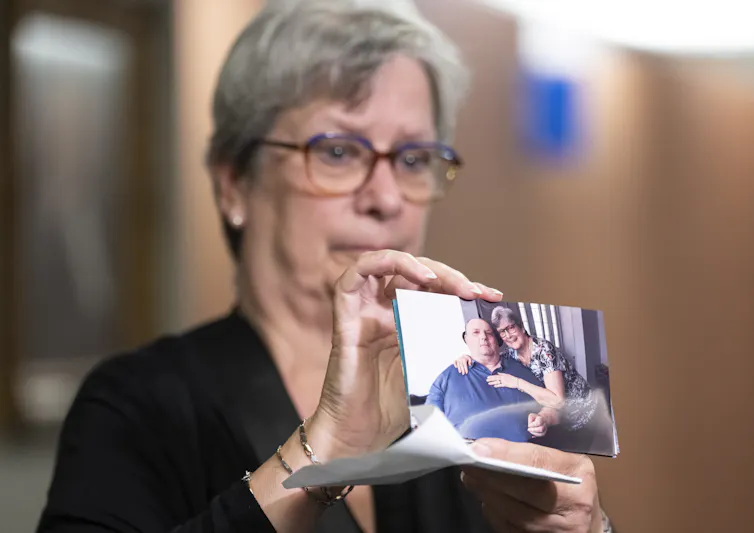 Sylvie Brosseau shows a photo of her herself with her husband at the courthouse in Montréal in May 2025. Brosseau’s partner, Normand Meunier, requested medical assistance in dying after getting pressure sores during a hospital stay.
THE CANADIAN PRESS/Christinne Muschi
Sylvie Brosseau shows a photo of her herself with her husband at the courthouse in Montréal in May 2025. Brosseau’s partner, Normand Meunier, requested medical assistance in dying after getting pressure sores during a hospital stay.
THE CANADIAN PRESS/Christinne Muschi
In her book Dispatches from Disabled Country, activist, educator and researcher Catherine Frazee provides an alternative vision of living with a disability. She uses a metaphor of Disabled Country to describe a “place of refuge for outlaws from the rules of fitting in a place where the value of human life is intrinsic, not contingent on a place that yields itself to our being and our capacity to flourish.”
Re-examining Canada’s disability policy story
From a policy-research perspective, understanding these narrative dynamics is essential for evaluating the effects of laws such as the ACA and for anticipating the implications of MAID expansion.
Scholars argue that policy narratives influence everything from budget priorities to program eligibility criteria and institutional cultures. They also shape how disabled people imagine their futures — an increasingly important dimension of well-being research.
As Canada reflects on the International Day of Persons with Disabilities, emerging evidence underscores the importance of aligning disability policy with the lived realities documented through research, monitoring processes and personal accounts.
Examining the narratives embedded in policy frameworks can help clarify how laws and institutions either support or hinder long-term flourishing for disabled people, and can offer insights into how stories told in policies ultimately align with societal values.
- Discrimination
- Disability
- MAID
- medical assistance in dying
- access to care
Events
Jobs
-
 Respect and Safety Project Manager
-
Associate Dean, School of Information Technology and Creative Computing | SAE University College
-
Senior Lecturer, Clinical Psychology
-
University Lecturer in Early Childhood Education
-
Case Specialist, Student Information and Regulatory Reporting
 Respect and Safety Project Manager
 Associate Dean, School of Information Technology and Creative Computing | SAE University College
 Senior Lecturer, Clinical Psychology
 University Lecturer in Early Childhood Education
 Case Specialist, Student Information and Regulatory Reporting
- Editorial Policies
- Community standards
- Republishing guidelines
- Analytics
- Our feeds
- Get newsletter
- Who we are
- Our charter
- Our team
- Partners and funders
- Resource for media
- Contact us
-
-
-
-
Copyright © 2010–2025, The Conversation