
 By
Andy Boxall
Published 52 minutes ago
Andy is a seasoned technology journalist with more than 15 years experience in the mobile industry, writing for Digital Trends, Wired, and more. During that time he has reviewed hundreds of smartphones and tablets, dozens of smartwatches, and a host of smart rings and smartglasses too.
His daily mobile tech life includes Android and iOS devices, smart rings, and a smartwatch unless it's a special ocassion, when a traditional watch takes its place on his wrist. He has attended multiple CES, MWC, and IFA tradeshows, has a passion for photography and cars, listens to far too much K-pop, and always has a strong opinion on the state of the tech industry.
You can find Andy's portfolio of work on his Authory page.
Sign in to your Android Police account
Summary
Generate a summary of this story
follow
Follow
followed
Followed
Like
Like
Thread
Log in
Here is a fact-based summary of the story contents:
Try something different:
Show me the facts
Explain it like I’m 5
Give me a lighthearted recap
By
Andy Boxall
Published 52 minutes ago
Andy is a seasoned technology journalist with more than 15 years experience in the mobile industry, writing for Digital Trends, Wired, and more. During that time he has reviewed hundreds of smartphones and tablets, dozens of smartwatches, and a host of smart rings and smartglasses too.
His daily mobile tech life includes Android and iOS devices, smart rings, and a smartwatch unless it's a special ocassion, when a traditional watch takes its place on his wrist. He has attended multiple CES, MWC, and IFA tradeshows, has a passion for photography and cars, listens to far too much K-pop, and always has a strong opinion on the state of the tech industry.
You can find Andy's portfolio of work on his Authory page.
Sign in to your Android Police account
Summary
Generate a summary of this story
follow
Follow
followed
Followed
Like
Like
Thread
Log in
Here is a fact-based summary of the story contents:
Try something different:
Show me the facts
Explain it like I’m 5
Give me a lighthearted recap
A while back, I spent a couple of years without a laptop and used my Apple iPad Pro (2020) with the Magic Keyboard as its replacement.
During that time, I used it a lot, mainly because the keyboard is so easy and comfortable to type on quickly.
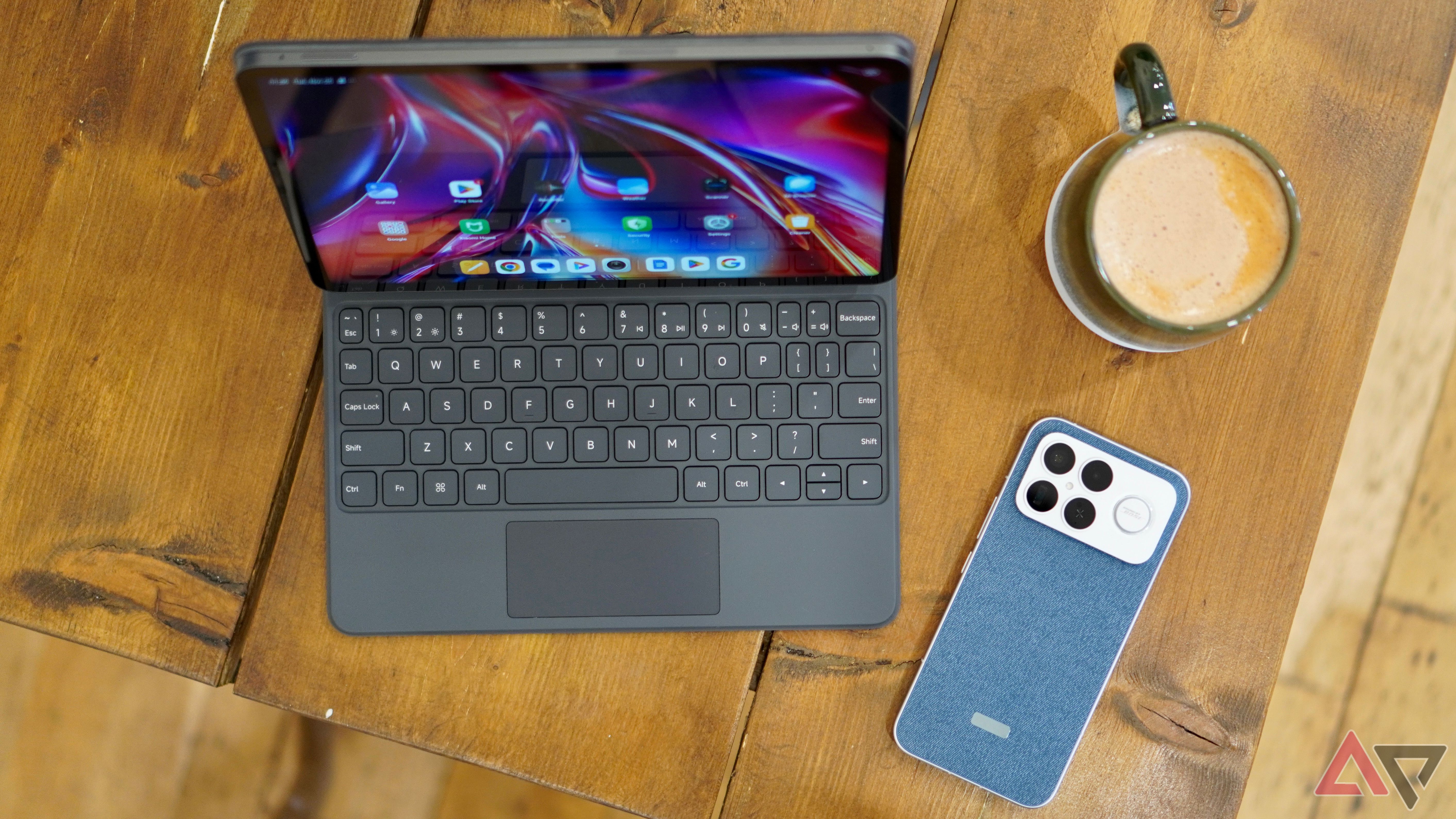
I’ve been giving the Poco Pad X1 with its Floating Keyboard accessory a try, and it has transported me back to that period in a very good way.
Fantastic keyboard
It rivals the best

Keyboard cases for tablets are quite hard to get right.
Ideally, they need the right amount of key travel, natural spacing, backlit keys, a place to rest your palm, preferably a decent touchpad, and a sturdy flat base so it can be used on your lap.
This is quite a list of must-haves, and even when each box gets ticked, it can still fail if it doesn’t “feel” right when you type.
Apple’s Magic Keyboard is a brilliant example of when everything comes together, and so is the Poco Pad X1’s Floating Keyboard.
 Poco Floating Keyboard (left) and Apple Magic Keyboard
How has Poco pulled off this feat? By making its keyboard almost identical to the Magic Keyboard.
From the overall size to the shape of the individual keys, and even the hinge design, it’s quite hard to tell them apart.
In the photo above, the Magic Keyboard is the one on the right with the missing Shift key. I told you it was well-used.
The typing experience is glorious.
I typed almost all of my Poco F8 Ultra review on it, through Google Docs, and I wouldn’t have been any faster if I’d used the iPad or my usual Logitech MX Keys Mini attached to my Mac Mini.

Each key has a soft, but perfectly weighted response, the spacing is just right for my fingers and typing style, and the touchpad is smooth and accurate.
In the Settings menu, you can adjust the backlight or let it do so automatically, tune the pointer speed, learn shortcuts, or even create your own.
The tablet can be angled for the right view, and the whole thing folded down into a handy carry size. It’s the best screen/keyboard tablet package I’ve used in a while.
Is the tablet good?
A great media machine

Even when I used my iPad for “work,” it was mostly typing into a word processor and browsing Chrome, with a few emails and chats too. Nothing strenuous. The rest of the time, any tablet I’ve owned has been for video and a few games.
Using tablets like the OnePlus Pad Lite showed me I didn’t need big power for any of this, and the Poco Pad X1’s specification is more than adequate.
The Qualcomm Snapdragon 7+ Gen 3 may not be the latest-and-greatest, and 8GB of RAM is fairly standard, but the lovely screen makes up for any (perceived) shortfall.

The 11.2-inch screen has a 345 pixel-per-inch (ppi) density from a 3,200 x 2136 pixel resolution, above what you see on the 11-inch Samsung Galaxy Tab S11.
It looks fantastic, full of bright colors, deep blacks, and just the right contrast levels. The 800 nits peak brightness is acceptable, but it may be a problem in really sunny conditions.
Audio backs up the great visuals, with plenty of volume from the quad speakers and only a little distortion above 75% volume.

Android 16 with Xiaomi’s HyperOS 3 interface is surprisingly good on a tablet, with varied split screen and floating window options for multitasking, stylus support, and, provided you don’t want specific pro-level apps, you can get things done.
I haven’t used the tablet enough to fully assess battery performance. It’s an 8,850mAh cell, and based on what I’ve seen so far, it should return between six and nine hours of screen time on a single charge. This is only an estimate, though.
What are the downsides?
Availability is the big one

The combination of tablet and keyboard makes it a heavy device to carry around, despite its portable size.
Together they weigh 1.095kg, more than my 11-inch iPad Pro and Magic Keyboard at 1.059kg. This is a consideration if you intend to use it as a laptop replacement.
The Poco Pad X1 doesn’t have a fingerprint sensor and relies on face recognition instead. It works. Still, it’s not only less secure, but it can also be less convenient than a fingerprint sensor. I’d have liked to see both.

Like the Poco F8 Ultra, the Pad X1 isn’t unique. Poco is part of the Xiaomi family, and the Xiaomi Pad 7 is essentially the same device as the Pad X1, just with a different brand name on it.
It won’t matter which one you choose, and this just ends up being confusing to the customer.
The last downside is availability. Poco doesn’t officially release its hardware in the US, meaning you’ll have to import one.
Good value
No need to spend a fortune

All the good aspects of the Poco Pad X1 would be washed away if it cost the same as a laptop, with lofty promises of being the one and only computing device you’ll need.
Poco isn’t going in that direction at all. The Poco Pad X1 costs $399, and the Floating Keyboard is an additional $199.
Poco Pad X1 SoC Qualcomm Snapdragon 7+ Gen 3 Display type Crystal-Clear Display 144Hz Display dimensions 11.2-inch Display resolution 3200 x 2136 RAM 8GB Storage 512GB Battery 8850mAh Charging speed 45W Charge options Wired Operating System Android 16 / HyperOS 3 Front Camera 8MP Rear Camera 13MP Wi-Fi connectivity Wi-Fi 6E Bluetooth Bluetooth 5.4 Dimensions 251 x 173 x 6.18mm Weight 500 grams Colors Blue / Grey Stylus Y Expand CollapseEven paired together, this is half the price of an Apple iPad Pro and Magic Keyboard, while Samsung only makes a $200 “Slim” keyboard for the $800 Galaxy Tab S11, which isn’t best suited for working on your lap.
I’ve really enjoyed using the Poco Pad X1 and the Floating Keyboard, and it only reinforces my belief that the best tablets are the ones that don’t cost a fortune, especially when the package is so well judged.
Follow Followed Like Share Facebook X WhatsApp Threads Bluesky LinkedIn Reddit Flipboard Copy link Email Close Thread Sign in to your Android Police accountWe want to hear from you! Share your opinions in the thread below and remember to keep it respectful.
Be the first to post Images Attachment(s) Please respect our community guidelines. No links, inappropriate language, or spam.Your comment has not been saved
Send confirmation emailThis thread is open for discussion.
Be the first to post your thoughts.
- Terms
- Privacy
- Feedback
 2 days ago
Google Messages will soon let you open shared media immediately after saving it
 2 days ago
Dangbei is discounting its projectors up to 50% for Black Friday on Amazon Canada
 1 day ago
The Poco F8 Ultra is a media powerhouse dressed in denim
 1 day ago
Most Galaxy users don't use AI photo editing features
Trending Now This premium Android tablet built for gaming now costs less than you'd ever expect
 One UI is about to solve a dark mode issue everyone forgot existed
 This Motorola phone is poised to become your next daily driver