
 Digineer Station/Shutterstock
One of the most important things you can do for your computer is to make sure you have the best antivirus software available installed. Although that seems straightforward, the sheer amount of different options available to choose from makes figuring out which one is the best choice a lot more complicated than it appears at face value. Thankfully, you don't have to figure it out alone. Consumer Reports, an independent organization that tests, reviews, and compares all kinds of different products, has put together a comprehensive guide breaking down all the pros and cons of popular antivirus software.
Consumer Reports gives each antivirus software it tests in the lab a rating out of five for several different factors: protection, access, demand, ease of use, messages and interface, help, advertising, data privacy, and use of resources. The report also breaks down which features are and aren't included with each product, like firewalls, filters, anti-spyware measures, and more. This information is then used to give each software a score out of 100.
Bitdefender and McAfee are widely considered to be among the top-rated antivirus software available, along with Norton, Avira, and Avast, and Consumer Report's data backed that up. They do have a couple of differences that set them apart, though. For starters, McAfee offers a full security suite, meaning that it's a package of assorted security tools offering protection for multiple types of vulnerabilities and issues. Bitdefender Antivirus, on the other hand, is anti-malware software designed to protect you from malicious software like viruses and Trojan horses. Bitdefender Antivirus is also free, while McAfee is a paid-for service. Consumer Reports rates Bitdefender Antivirus slightly higher than McAfee Total Protection overall, although not by much. The exact differences between the two are slightly more complicated.
How does Bitdefender Antivirus compare to McAfee Total Protection?
 Erman Gunes/Shutterstock
Although Bitdefender Antivirus has a slightly higher overall rating when comparing the data provided by Consumer Reports, the ratings given for each aspect of the two products are relatively evenly matched. Both McAfee Total Protection and Bitdefender Antivirus scored the same in lab tests across six different measures: protection, access, advertising, demand, help, and messages and interface. The main differences in terms of lab tests were found for ease of use, data privacy, and use of resources. Bitdefender Antivirus beat McAfee for ease of use and data privacy, while McAfee scored higher than Bitdefender Antivirus for use of resources.
Consumer Reports also gathered information on what is and isn't included with each product, including but not limited to firewalls, spam filters, and anti-spyware functionality. The two products were again similarly matched, with a few notable exceptions. McAfee provided a firewall, a tune-up function, and a password manager, whereas Bitdefender Antivirus did not. Besides that, they hit the same criteria, with both services offering anti-spyware measures and concise help. So, even though Bitdefender Antivirus slightly outranks McAfee, McAfee offers a couple more features — which makes sense considering that it's a full suite instead of a single software.
Overall, the free anti-malware software Bitdefender Antivirus rated slightly better than McAfee Total Protection in Consumer Reports' research. However, the two services are quite different, making it somewhat difficult to compare them. To some extent, which antivirus solution is best for you depends on which features you need and what your budget is. For example, if you needed a firewall, then Bitdefender Antivirus wouldn't be the better choice for you.
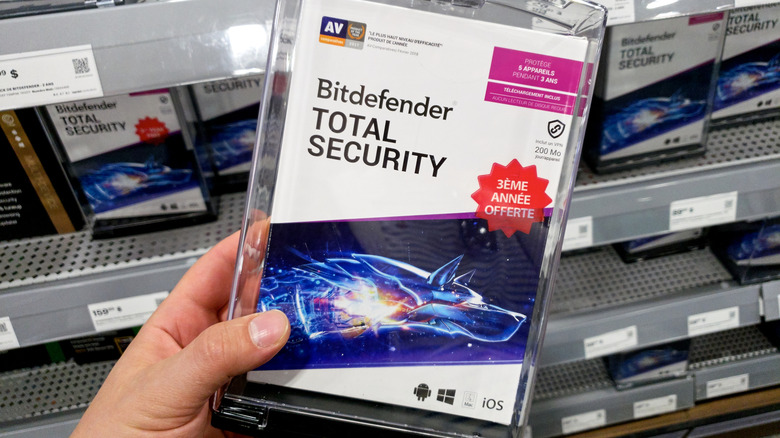
Consumer Reports also tested Bitdefender's security suite
 dennizn/Shutterstock
Bitdefender Antivirus is just one of Bitdefender's products — and it isn't the only one that Consumer Reports tested for their report. Besides their free antivirus software, Bitdefender also offers a couple of paid-for security suites. Previously, when Consumer Reports tested it, it was called Bitdefender Internet Security. However, going forward, Bitdefender Internet Security has been integrated into two different products: Bitdefender Total Security Individual and Bitdefender Premium Security Individual. That means that everything Consumer Reports tested about Bitdefender Internet Security is included in these two new services, alongside a number of other features.
Bitdefender's security suites are more in line with McAfee Total Protection, as they offer multiple security tools and overall more features than Bitdefender Antivirus. When Consumer Reports tested Bitdefender Internet security, they used the same metrics as they did for Bitdefender Antivirus and McAfee Total Protection. It largely scored the same as Bitdefender Antivirus and again came out on top when compared against McAfee's similar offering. However, Bitdefender's security suite was revealed to offer a few more features than its free counterpart — and also more features than McAfee Total Protection. McAfee also offer other protection plans and services that weren't accounted for in Consumer Reports' analysis.
According to Consumer Reports, the Bitdefender Internet Security suite offers a spam filter, parental filter, banking protection, anti-ransomware, and email protection, whereas McAfee Total Protection does not. Moreover, per Bitdefender, the upgraded packages now available come with password managers, cryptomining protection, and more. Based on their analysis, Consumer Reports recommends both McAfee Total Protection and multiple Bitdefender products. However, they aren't all recommended equally, with Bitdefender receiving a higher score and more features.