- Home
Edition
Africa Australia Brasil Canada Canada (français) Català España Europe France Global Indonesia New Zealand United Kingdom United States Skip to content Edition:
Global
Edition:
Global
- Africa
- Australia
- Brasil
- Canada
- Canada (français)
- Català
- España
- Europe
- France
- Indonesia
- New Zealand
- United Kingdom
- United States
Academic rigour, journalistic flair
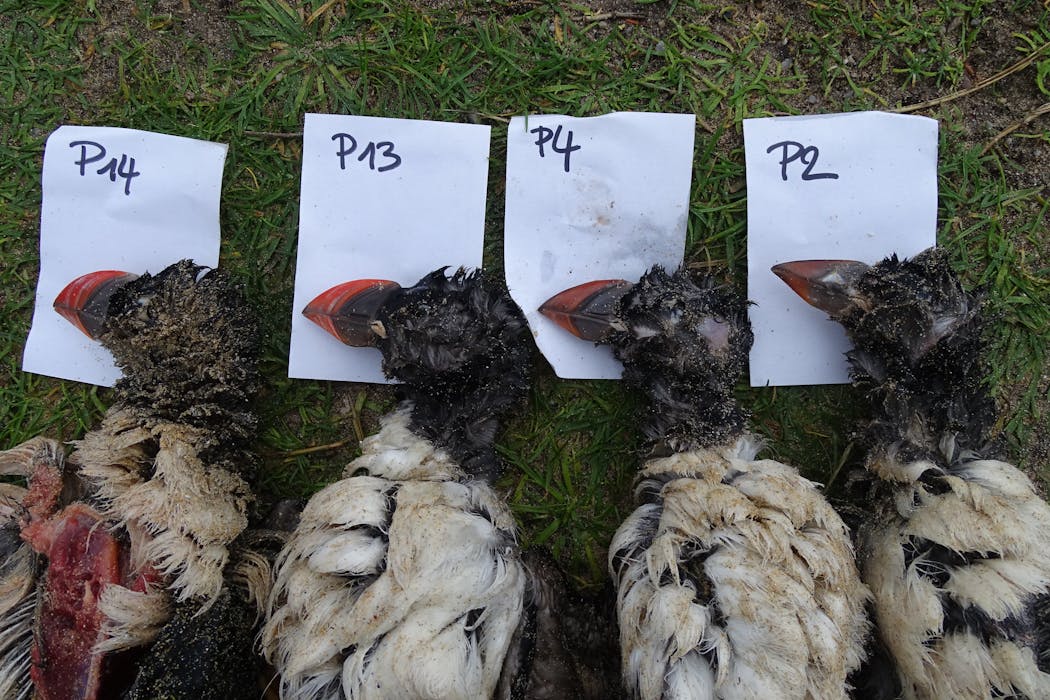
 Puffins are dying from starvation due to recent storms.
Bernard Cadiou, CC BY-ND
Thousands of dead puffins are washing up on Europe’s beaches – why it’s been such a dangerous winter for seabirds
Published: February 27, 2026 4.16pm GMT
Ruth Dunn, Lancaster University
Puffins are dying from starvation due to recent storms.
Bernard Cadiou, CC BY-ND
Thousands of dead puffins are washing up on Europe’s beaches – why it’s been such a dangerous winter for seabirds
Published: February 27, 2026 4.16pm GMT
Ruth Dunn, Lancaster University
Author
-
 Ruth Dunn
Senior Research Associate in Marine Ecology, Lancaster University
Disclosure statement
Ruth Dunn has previously received funding from NERC.
Partners

Lancaster University provides funding as a founding partner of The Conversation UK.
View all partners
DOI
https://doi.org/10.64628/AB.puxwntw6f
https://theconversation.com/thousands-of-dead-puffins-are-washing-up-on-europes-beaches-why-its-been-such-a-dangerous-winter-for-seabirds-276545 https://theconversation.com/thousands-of-dead-puffins-are-washing-up-on-europes-beaches-why-its-been-such-a-dangerous-winter-for-seabirds-276545 Link copied Share articleShare article
Copy link Email Bluesky Facebook WhatsApp Messenger LinkedIn X (Twitter)Print article
February 2026 has seen thousands of dead seabirds washing up along the coastlines of the UK, France, Spain and Portugal.
There’s evidence that these “wrecks” (where large numbers of seabirds are found along beaches) are becoming increasingly common because of climate change. Worse still, these dead birds – including Atlantic puffins and European shags – only tell a fraction of the story. Many more are likely to have been lost out in the stormy open ocean.
Even as someone who has dedicated the last decade of my life to researching seabirds, I have found myself beginning to feel desensitised to the increasingly regular news of these dead birds found in great numbers. Current estimates are high: over 20,000 birds swept up along beaches in France alone since mid January.
Seabirds’ bodies are also being found on beaches along the the North Sea, off the southern coast of Ireland and the Bay of Biscay.
Although increasing temperatures are perhaps the most well-known consequence of human-induced climate change, increased storm frequencies and intensities are another critical symptom.
A number of storms have swept across Europe so far this year. Storm Chandra poured down over the UK and other parts of Europe in late January, while six further named storms blew across Portugal, Spain and France in quick succession throughout February. Looking at the evidence, it is possible that this ensemble of storms concocted a lethal cocktail of conditions for wintering seabirds, by creating multiple wreck events over a short amount of time.
The back-to-back barrage of storms this winter has provided little respite for seabirds that must struggle with strong winds, torrential rain and high seas, desperately hungry but apparently unable to feed. The bodies of birds washed up in wreck events are skinny and their muscles are very hard (indicated by high levels of lactate). Despite paddling hard amongst the waves, they were unable to catch enough prey to survive.
Studying survival
The Isle of May Long-Term Study, led by the UK Centre for Ecology and Hydrology, has been monitoring seabirds since 1973, making it one of the most data-rich studies of its kind.
This monitoring includes looping small metal rings, engraved with unique identification codes, around the legs of seabirds. These rings allow corpses to be traced back to the Isle of May, off the east coast of Scotland, or other seabird colonies where seabird ringing takes place.
Every year, the Isle of May team deal with these reports and use them to understand seabird deaths and survival rates. In 2026, Josie Hewitt, an expert in avian ecology, has received more than usual: 33 dead shags and nine dead puffins throughout February.
Among these numbers are birds that survived the avian flu outbreak in 2022-23, and the stormy 2023-24 winter, making these reports even more heartbreaking.
Seabird colonies are often home to thousands of birds during the breeding season – too many to ring. Many more that don’t have these rings are also being found. Others swallowed by the waves may never be recovered.
In winter, seabirds must forage intensively to catch enough prey to survive the cold, while also building up reserves for the approaching breeding season. Many are therefore experts at navigating the underwater marine environment.
Puffins flap their wings to move through the water to chase fish, while shags propel themselves by thrusting their feet.
However, when bad weather hits, seabirds can struggle. Even during their summer breeding seasons, when storms are less common and less severe, they are more reluctant to forage in high winds, struggling to capture prey in churned-up waters.
Populations in crisis
Seabirds live for a long time (one victim of the current wreck was a 34-year-old puffin) and only breed once a year, meaning their populations rely on adults surviving. These huge numbers of deaths can therefore have a long-term impact on population trends.
This is especially true when adult birds, which are generally better at surviving winters than juveniles, are among the casualties. Worse still, these events are happening increasingly regularly, with less time to recover in between.
When I stayed on the Isle of May last summer, there was an eerie quietness along large stretches of the island’s rocky borders. During previous visits, I had become used to sharing the island with more than 500 noisy, smelly pairs of breeding shags – each pair taking great care of their oversized nests, gently shifting broken twigs and fronds of seaweed into the perfect position with their beaks.
Though widely considered less charismatic than the puffins that strut around clumps of grass and sea campion, proudly displaying beaks full of silver fish, fierce-looking shags have a beauty too – with their shining black plumage, piercing green eyes and prehistoric-looking webbed feet.
The Isle of May shag population declined to a fraction of its previous size following the storms of winter 2023-24, and is being hit again by this year’s storms. It’s devastating to think just how few of these birds might be on the island this summer.
It is disappointing that at a time when our seabirds are facing unprecedented threats to their survival, scientific funding is becoming increasingly squeezed in the US and the UK. Continuation of long-term studies such as the one on the Isle of May is crucial to understanding the impacts of climate change on our seabirds.
- Climate change
- Rain
- Seabirds
- Storms
- Sea
- storm damage
Events
Jobs
-
 NeuroPhysiotherapist (Research)
-
Psychology Clinical Supervisor
-
Visiting Professor - 2027 Australia-Korea Chair in Australian Studies at Seoul National University
-
Department Chair and Associate Professor/Professor of Media and Communication
-
1 year editorial cadetship
 NeuroPhysiotherapist (Research)
 Psychology Clinical Supervisor
 Visiting Professor - 2027 Australia-Korea Chair in Australian Studies at Seoul National University
 Department Chair and Associate Professor/Professor of Media and Communication
 1 year editorial cadetship
- Editorial Policies
- Community standards
- Republishing guidelines
- Analytics
- Our feeds
- Get newsletter
- Who we are
- Our charter
- Our team
- Partners and funders
- Resource for media
- Contact us
-
-
-
-
Copyright © 2010–2026, The Conversation