
- News
- World
- Americas
- US politics
U.S. senator says no ‘large-scale’ American force will be deployed inside Iran and rejects notion that president needs a ‘plan’ for the future
John Bowden in Washington, D.C. Sunday 01 March 2026 16:43 GMT- Bookmark
- CommentsGo to comments
Bookmark popover
Removed from bookmarks
Close popover
 US military shares footage said to show wave of attacks on Iran
Sign up for the daily Inside Washington email for exclusive US coverage and analysis sent to your inbox
Get our free Inside Washington email
Get our free Inside Washington email
Email*SIGN UPI would like to be emailed about offers, events and updates from The Independent. Read our Privacy notice
Republican Senator Lindsey Graham denied on Sunday that the Trump administration needed a plan to ensure that Iran would not continue to be a state sponsor of terrorism following the death of the Ayatollah Khamenei on Saturday in a U.S.-Israeli strike.
One of D.C.’s longest and most vocal proponents of using military force to confront the Iranian government for years, Graham appeared on NBC’s Meet the Press on Sunday to cheer the joint U.S. and Israeli strikes on Iran this weekend which began in the early hours of Saturday morning. The strikes are confirmed to have killed Iran’s supreme leader and dozens of others. Three U.S. service members have been killed since the hostilities erupted and Iran launched a wave of missile attacks across the region in retaliation.
The U.S. president confirmed on Saturday that severely disrupting or deposing the Iranian regime was the intention of the latest round of attacks as he urged Iranian citizens and members of the Revolutionary Guard corps (IRGC) to join with protesters and topple the government.
But on Sunday, the South Carolina senator rejected entirely the notion that the U.S. or Donald Trump would be held responsible for whatever emerged from the ashes of the current theocratic Iranian government should the Ayatollah’s death indeed cause it to collapse.
“Our goal is to make sure [Iran] cannot become again the largest state sponsor of terrorism,” Graham said on Meet the Press, explaining that Iran’s people would be in charge of charting the country’s new course. “That’s a win for us. That’s a win for the region.”
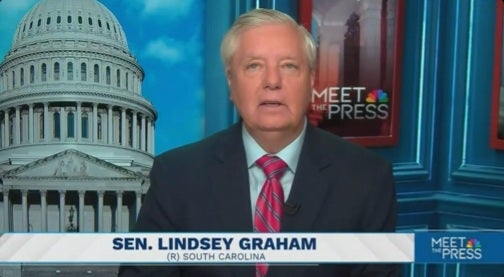 open image in gallerySen. Lindsey Graham disputed the idea that the U.S. needed a plan for guiding Iran's future after the death of the Ayatollah (NBC - Meet the Press)
“But is there a plan to make sure that happens?” asked NBC’s Kristen Welker. “Does the the president have a plan to guarantee that that happens?”
“No!” Graham responded. “It’s not his job or my job to do this. How many times do I have to tell you? Our job is to make sure Iran is no longer the largest state sponsor of terrorism. To help the people reconstruct a new government. No boots on the ground. We don’t own – you know this idea, ‘you break it, you own it?’ I don’t buy that one bit. It’s in America’s interest to make sure the Ayatollah’s dead. He’s dead.”
A second Republican who backed Donald Trump’s strikes on Iran that caused the death of the Ayatollah Hosseini Khamenei seemed to waver on one of Graham’s points on Sunday during his own interview. Sen. Tom Cotton told CBS Face the Nation that the president had no plans for a “large” American force on the ground, but didn’t rule the idea out entirely.
“The president has no plan for any kind of large-scale ground force inside of Iran,” said Cotton, chair of the Senate Intelligence Committee and one of the so-called “Gang of Eight” notified by the White House ahead of strikes on Iran.
Cotton suggested that search-and-rescue operations could be initiated for downed pilots in Iranian territory if the need arose, but said that the U.S. military campaign against Iran would be a largely air- and sea-based assault in the days to come.
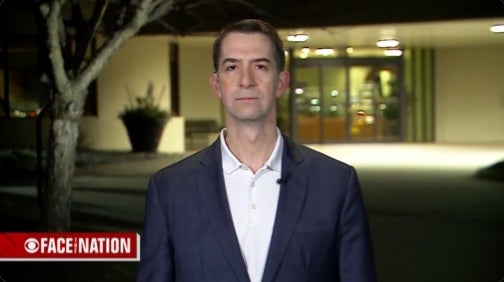 open image in gallerySen. Tom Cotton said on Sunday that the U.S. would not have a 'large-scale' presence within Iran (CBS - Face the Nation)
Iranian state television confirmed the death of the supreme leader on Saturday. Other figures, such as President Masoud Pezeshkian, remain in power and the country’s military continues carrying out missile attacks around the region as U.S. and Israeli strikes continue. A strike that hit a girls’ school in southern Iran has now killed 148 people and wounded dozens more in the largest mass casualty event since the conflict began, according to Iranian media, and others have been reported killed in Iran, Israel and elsewhere in the Middle East including the United Arab Emirates.
The country’s former hardline president Mahmoud Ahmadinejad is among those reported dead by some Iranian news outlets, but his death has not been confirmed by prominent officials.
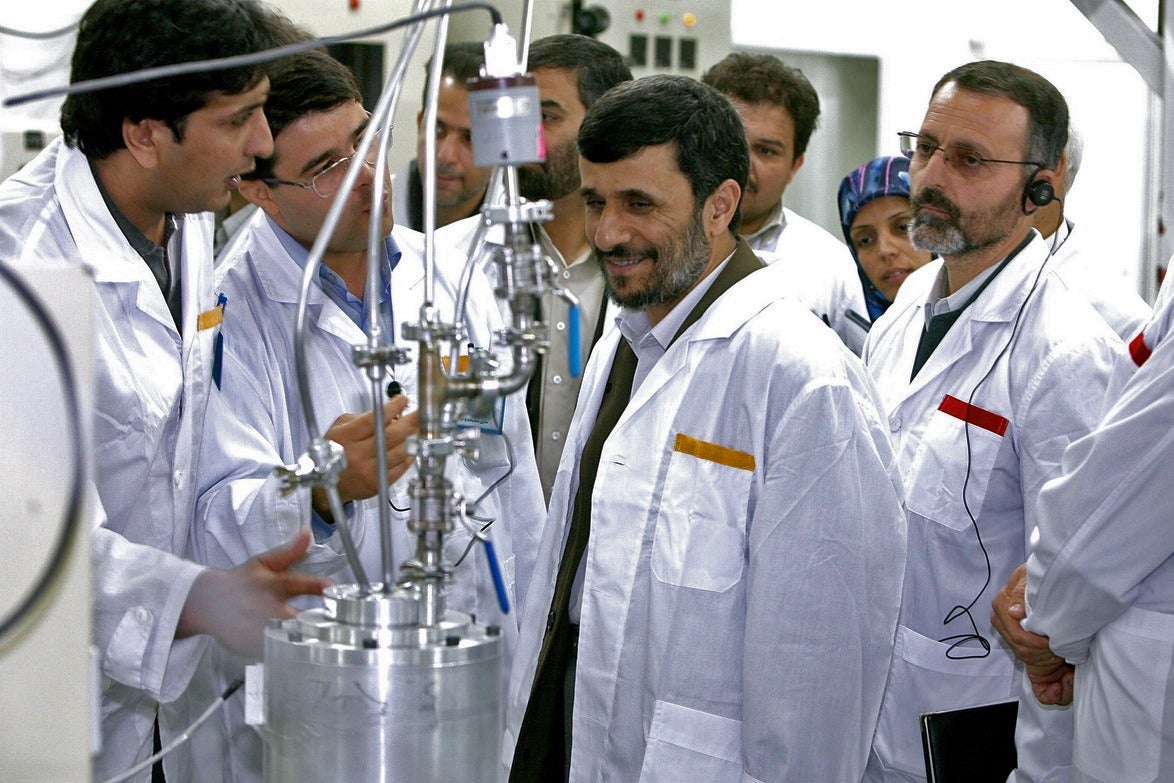 open image in galleryFormer president Mahmoud Ahmadinejad, center, was reported killed in the airstrikes (Getty Images)
Saturday’s airstrikes and missile attacks closely followed negotiations Thursday in Geneva aimed at resolving U.S. demands for Iran to rein in its nuclear and ballistic weapons programs.
Axios reporting indicates that planning for the strikes, including the assassination of Khamenei, began weeks ago with a visit to Mar-a-Lago by Israeli Prime Minister Benjamin Netanyahu. Talks Thursday in Geneva were a last-ditch effort to avert the strikes, but U.S. officials say that negotiators Jared Kushner and Steve Witkoff came out of the evening session and reported to the president that Iran was still far away from the U.S.’s list of demands — which were reportedly steep, and only offered the prospect of limited sanctions relief for sustained future compliance. Trump ordered the attacks a day later.
"If the Iranians had come to Geneva and given Trump what he wanted, he would have pulled the brakes on the military track. But they were arrogant and thought he wouldn't take action," an Israeli official told the outlet.
More about
IranLindsey GrahamAyatollah KhameneiDonald TrumpU.S.Meet the PressTom CottonAyatollah Ali KhameneiJoin our commenting forum
Join thought-provoking conversations, follow other Independent readers and see their replies
Comments