The Independent's journalism is supported by our readers. When you purchase through links on our site, we may earn commission.
- Travel
- News & Advice
APD is set to increase in April 2026 and 2027, with a family of four flying premium economy to Orlando paying over £1,000
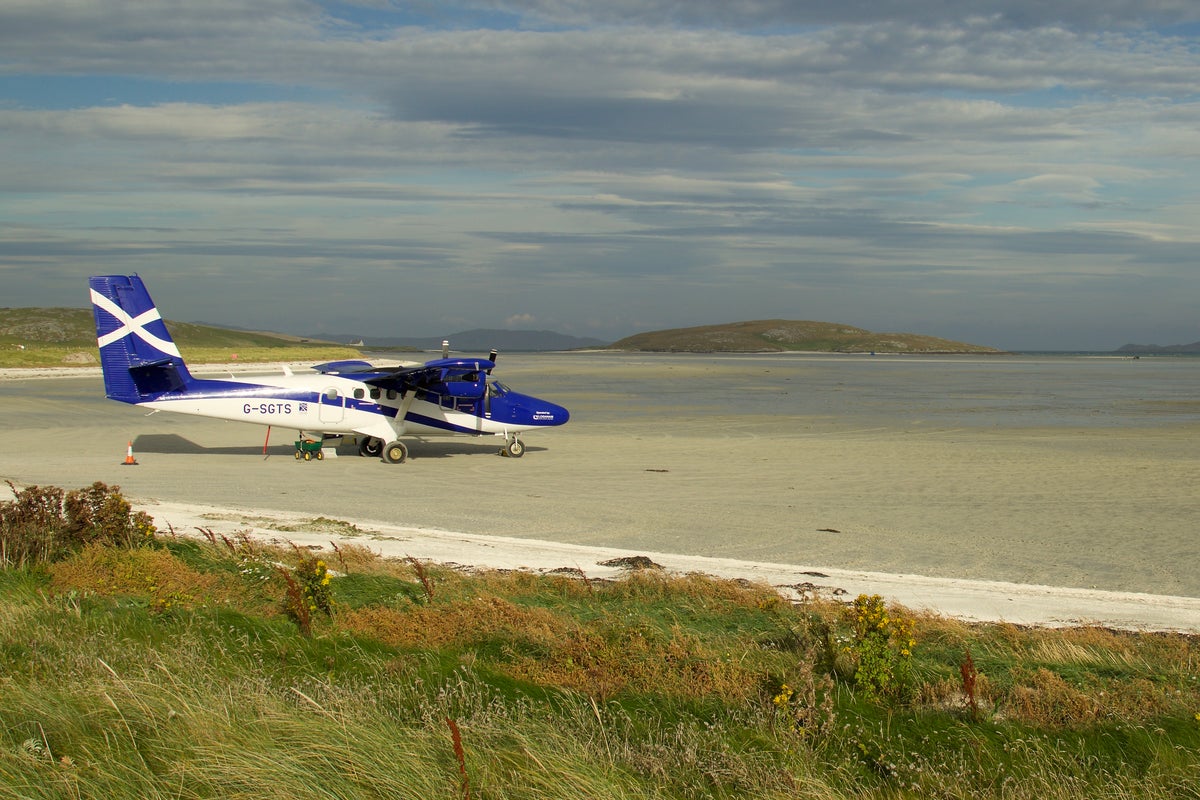
Simon CalderSimon CalderWednesday 26 November 2025 17:13 GMTComments Start here: Scottish Highlands and Islands airports, including Barra and Inverness, are exempt from APD (David Savile/HIAL)
Sign up to Simon Calder’s free travel email for expert advice and money-saving discounts
Get Simon Calder’s Travel email
Get Simon Calder’s Travel email
Email*SIGN UPI would like to be emailed about offers, events and updates from The Independent. Read our Privacy notice
Air passenger duty (APD) is set to rise on April Fools’ Day in both 2026 and 2027. Chancellor Rachel Reeves has imposed an above-inflation increase from 1 April 2026, and one in line with the retail prices index a year after that. By the summer of 2027, a family of four flying premium economy to Orlando will paying over £1,000 in tax for leaving the UK in anything better than basic economy.
APD is the tax that passengers aged 16 and over must pay when flying from most UK airports. is seen as a perfect tax by politicians. It is difficult to avoid and easy to collect, because airlines do all the work and send the Treasury a cheque. As the Treasury said when publishing the increase: “HMRC will not incur any costs making these changes.”
APD is unique to the UK, and a topic of much controversy:
- Is it a “green” tax or simply a revenue-raising device?
- Does it encourage less damaging behaviour by travellers or inadvertently cause more harm?
- Should it be eliminated, as Michael O'Leary of Ryanair has said, or sharply increased?
The debate is set to intensify, along with an increasing number of travellers avoiding APD through a variety of means.
These are the key questions and answers.
A brief history of air passenger duty?
The man responsible for APD was the last Conservative chancellor of the 20th century, Kenneth Clarke. He later told me: “Aviation was in an unusual position in that it’s the only form of transport where no one was paying any tax on the fuel that it uses.
“For years and years governments have regarded it as totally normal to impose tax on petrol, diesel fuel and everything used by land and sea. For historic reasons nobody was placing any tax on air fares.
“For me that was an anomaly, not least because people who use aviation tend to be slightly more prosperous than those who use other forms of transport.”
As international aviation agreements generally rule out a tax on jet kerosene, Mr Clarke instead imposed air passenger duty of £5 on each European flight, and £10 on long-haul services. It applied to all passengers above one year of age starting a journey at a UK airport, and took effect in 1994 – just a year before easyJet started flying.
What has happened since?
Mostly, APD has increased – partly because it can be presented as a “green” initiative, dampening demand for aviation. And many of the people who pay it are foreign visitors and do not vote in the UK.
Mr Clarke’s successor as chancellor, Labour’s Gordon Brown, doubled the tax for business- and first-class seats. (One bizarre loophole, since closed, meant that passengers on the world’s most expensive aircraft, Concorde, paid the same as budget airline travellers to Morocco.)

Get a free fractional share worth up to £100.Capital at risk.
Terms and conditions apply.
Go to websiteADVERTISEMENT
Get a free fractional share worth up to £100.Capital at risk.
Terms and conditions apply.
Go to websiteADVERTISEMENT
Since 2016, APD has not applied to under-16s travelling in basic economy – but it is payable for higher classes.
In a rare counter to the general upward trend, in 2023, Rishi Sunak halved air passenger duty on domestic flights – encouraging a move from rail, sea and road to air for journeys within the UK.
How is air passenger duty calculated?
The rate depends on two factors: the traveller’s final ticketed destination and the class of travel.
“Final ticketed destination”
If you are travelling on a “through ticket,” eg. Manchester-Amsterdam-Los Angeles or Birmingham-Frankfurt-Mumbai, the long-haul rate applies (unless you are spending over 24 hours at the transit point).
Class of travel
In anything but basic economy, a higher rate is payable – and all passengers aged two or over must pay it. The extra tax is triggered by “a seat pitch in excess of 40 inches”.
Passengers on private jets pay a vast amount more. These are defined as: “Aircraft of 20 tonnes and above with fewer than 19 seats.”
In terms of destinations, there are four different categories: UK domestic flights, plus three classes for international travel.
- Band A: Destinations abroad whose capital city is 2,000 miles or less from London. This covers all of Europe and parts of North Africa
- Band B: Destinations whose capital city is 2,001-5,500 miles from London
- Band C: Destinations whose capital city is over 5,500 miles from London
What are the rates?
From 1 April 2025, they are as follows (second figure is for anything but basic economy):
- UK domestic £7 or £14
- Band A £13 or £28
- Band B £90 or £216
- Band C £94 or £224
For private jets, the tax is between £84 and £647 per person.
From 1 April 2026, they will all rise, as follows
- UK domestic £8 or £16
- Band A £15 or £32
- Band B £102 or £244
- Band C £105 or £253
For private jets, the tax will be between £142 and £1,141 per person.
From 1 April 2027, for the first time air passenger duty will start being levied in pence as well as pounds:
- UK domestic £8.26 or £16.52
- Band A £15.49 or £33.04
- Band B £105.33 or £251.95
- Band C £109.46 or £261.25
For private jets, the tax will be between £146.63 and £1,178.20 per person.
What’s the effect on families?
For a family of four (with children between two and 15), the total APD from April 2027 will be:
- UK: £16.52 in basic economy, £66.08 in premium economy or better.
- Europe: £30.98 or £132.16.
- Most long-haul destinations: £210.66 or £1,007.80.
- Ultra-long-haul destinations: £218.92 or £1,045.
How can I avoid APD?
These are some of the tax-avoiding options:
1. Don’t fly.
2. Be under 16 and travel in basic economy (or under two in business class)
3. Fly into the UK on one plane and out within 24 hours on another and have them both included in the same ticket.
4. Be a pilot or member of cabin crew on duty.
5. Be repatriated after being refused admission to the UK.
6. Fly on a route from a UK airport that is not subject to air passenger duty.
I can’t manage 1, 2, 3, 4 or 5; how do I find an APD-free flight?
Fly from the Scottish Highlands and Islands Region, which includes Orkney, Shetland, the Western Isles, Oban, Campbeltown and Inverness.
Remarkably, even if you are fly from Inverness to London Heathrow and onwards to a long-haul destination, the tax saving applies. Flying from Aberdeen to Singapore on British Airways on 1 April, for example, costs £583 return – but from Inverness the fare is just £497, saving 15 per cent on the trip.
Long-haul flights direct from Belfast are also free of tax, but there are few of them. Note that you cannot dodge APD by flying to another UK hub, as you can in the case of Inverness.
To be kinder to the planet, you could travel terrestrially to a foreign airport: by sea (or overland from Northern Ireland) to Dublin; by sea to the Netherlands; or on a Eurostar train to Paris, Brussels or Amsterdam.
How can I reduce APD?
Heading for the US? You could try the Dublin Dodge: fly to the Irish capital on a cheap no-frills flight, and pick up a tax-free flight on Aer Lingus, American Airlines, Delta or United to your final destination. There is an added benefit of travelling via the Irish capital: you complete US arrival formalities while at Dublin airport, and on touchdown in America you are regarded as a domestic passenger.
For other destinations, the same principle applies to reduce your APD liability drastically. Fly to Amsterdam, Paris, Madrid or any other European airport and buy a separate ticket from there. I flew to Seoul from Zagreb recently, travelling from Birmingham via Beauvais to keep fares as well as tax low.
The problem with such “self-connects” is the risk of a misconnection. And because the UK is so competitive for air fares, you may not save money. For example, China Southern is selling flights in late November 2025 from London Heathrow to Melbourne for just £557 return – of which one-sixth of the fare is air passenger duty.
A smarter way to cut the tax without jeopardising connections is to build in a stopover of 24 hours or more at the connecting point. The airline should automatically charge you the lower rate. In effect, since you are saving £77 (in 2025-26), the chancellor is paying for a short break for you.
Reykjavik and Istanbul are particularly good for North America and Asia/Africa respectively.
What if I fly in economy on the first leg but business for the rest?
If you are on a through ticket, the business-class rate applies to the whole journey.
If I book a flight and don’t show up for it, who gets the tax?
The airline. While carriers collect APD up to a year in advance, the obligation to pass it on to the government crystallises only when the passenger flies. In theory you can claim it back, but in practice some airlines and travel agents impose fees that are designed to render attempts pointless – with a handling fee that is the same or more than the tax refund.
How do I get a refund of APD if I don’t travel?
Some carriers make it straightforward. EasyJet says: “If you cancel, miss or do not take your flight ... you can claim a full refund of government tax for the flight(s) you do not take. You can do this by contacting our Customer Services Team. This is most easily done through the airline’s contact form. Select “Government Tax Refund” from the drop-down menu.
British Airways says: “ If you do not use your ticket, you will be entitled to claim a refund of any taxes, fees and charges which you paid, less a reasonable service charge.” If you booked direct with BA, you use the online refund portal.
Ryanair has a good online portal for refund applications. But also has a Government Tax Refund Administration Fee of £20 per passenger, which means it is pointless applying for Air Passenger Duty of £13 (rising to £15).
Virgin Atlantic says: “If your ticket is non-refundable and you do not use all or part of it, you can still apply a refund of taxes ... We will deduct an administration fee of no more than £30 per passenger.” As all Virgin Atlantic flights are long-haul, this is well worth applying for if you do not travel.
Wizz Air claims: “We pay all taxes and charges relating to your booking ... All such taxes and charges are non-refundable.” The airline implies that it has paid Air Passenger Duty in advance, whereas APD is payable only after the passenger has departed.
This piece was first published in February 2025 and is kept updated with the latest information.
Read more: Baggage allowance guide – luggage limits for British Airways, Ryanair, easyJet and more
More about
air passenger dutyEurostarBudgetJoin our commenting forum
Join thought-provoking conversations, follow other Independent readers and see their replies
Comments
