- Home
Edition
Africa Australia Brasil Canada Canada (français) España Europe France Global Indonesia New Zealand United Kingdom United States Edition:
Global
Edition:
Global
- Africa
- Australia
- Brasil
- Canada
- Canada (français)
- España
- Europe
- France
- Indonesia
- New Zealand
- United Kingdom
- United States
Academic rigour, journalistic flair
Maga explained: how personality and context shape radical movements
Published: December 3, 2025 5.46pm GMT
Magnus Linden, Lund University, Claire Campbell, Ulster University, Fredrik Björklund, Lund University
Authors
-
 Magnus Linden
Associate Professor of Psychology, Lund University
-
Claire Campbell
Lecturer in Social Psychology, Ulster University
-
Fredrik Björklund
Professor of psychology, Lund University
Disclosure statement
Claire Campbell works for Ulster University. She receives receives funding from PEACE PLUS for research on peace building.
Fredrik Björklund and Magnus Linden do not work for, consult, own shares in or receive funding from any company or organisation that would benefit from this article, and have disclosed no relevant affiliations beyond their academic appointment.
Partners

Lund University provides funding as a member of The Conversation UK.
View all partners
DOI
https://doi.org/10.64628/AB.myde6td3v
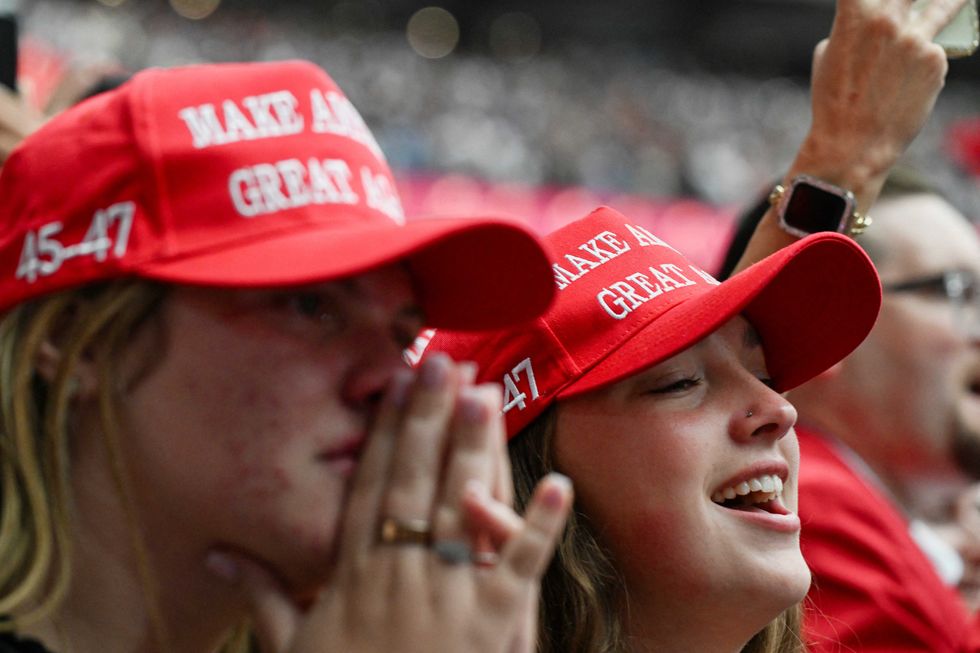
 Make American Great Again: Donald Trump’s loyal base.
Picture Architect/Alamy Live News
https://theconversation.com/maga-explained-how-personality-and-context-shape-radical-movements-270191
https://theconversation.com/maga-explained-how-personality-and-context-shape-radical-movements-270191
Link copied
Share article
Make American Great Again: Donald Trump’s loyal base.
Picture Architect/Alamy Live News
https://theconversation.com/maga-explained-how-personality-and-context-shape-radical-movements-270191
https://theconversation.com/maga-explained-how-personality-and-context-shape-radical-movements-270191
Link copied
Share article
Share article
Copy link Email Bluesky Facebook WhatsApp Messenger LinkedIn X (Twitter)Print article
It’s often said that Donald Trump’s power base in the Maga movement has contributed to the radicalisation of the Republican party. Political scientists worry about the implications of this for the future of American democracy itself.
One example of that radicalisation was the attack on the US Capitol on January 6 2021 in an attempt to overturn the result. Exacerbating that radicalisation is the movement’s hostility towards much of the mainstream media. This is something that has been amplified by the US president himself, who has famously referred to the media as “the enemy of the American people”.
But how has this radical movement movement emerged from the socially conservative Republican Party? The rise of Maga has marked an important political shift in America that has many liberal-minded people scratching their heads. Psychology studies can offer insights that can help explain the Maga movement’s motivations.
1. Fused identity
Identity is central to understanding the way Maga holds together as a group and can also explain many of its motives. Trump has been able to mobilise his base effectively by communicating that shared identity. And it’s this sense of common identity and purpose that has been so important in the development of Maga as a powerful political movement.
The almost absolute faith in Trump’s leadership has a lot to do with negative resentment of other groups that he singles out for criticism, particularly migrants, liberals and feminists. But it is actually a positive identification with white nationalism that is a stronger indicator of the sort of person who might identify with Maga.
Maga supporters unite around a shared perception of threat to their status, often related to issues of race and immigration. But it is also seen to be motivated by the desire to cultivate belonging and group pride as a way to regain lost esteem.
Some researchers also believe that even the act of wearing a Maga hat is a sign of what is known as “identity fusion” – when boundaries between the self and the group blur. When this occurs, wearing a Maga hat may be a symbol of who I am rather than just who I voted for.
This is significant since identity fusion is associated with reported willingness to undertake more extreme actions such as hurting people and damaging property to uphold the Trump community and to achieve his aims.
2. Moral self-righteousness
Maga members also tend to adhere to the idea that one’s own ethnic group is more morally pure than others. Maga ideology tends to divide America into “good” and “evil” groups, with themselves as good and out-groups, such as the ones mentioned above, cast as evil. This positions “true Americans”, the people who built the nation, patriots who have “had enough”, as part of the former.
Since it frames politics as a struggle over “right values and lifestyles”, such rhetoric heightens the risk of malignant moral superiority. When communicated by a leader, it creates in followers the sense that they have an obligation to act against these “evil” forces which threaten their group.
When this sense of superiority is threatened, it can lead to aggression, such as the assault on the US Capitol .
3. The right to dominate other groups
Aggressiveness in political groups such as Maga is also connected to what is known as “social dominance orientation”. This relates to belief in a hierarchy – the idea that one social group has the right to dominate other groups.
Research shows people who believe in hierarchy are more likely to disregard basic democratic principles. They see society as a “competitive jungle” where groups struggle for power and dominance.
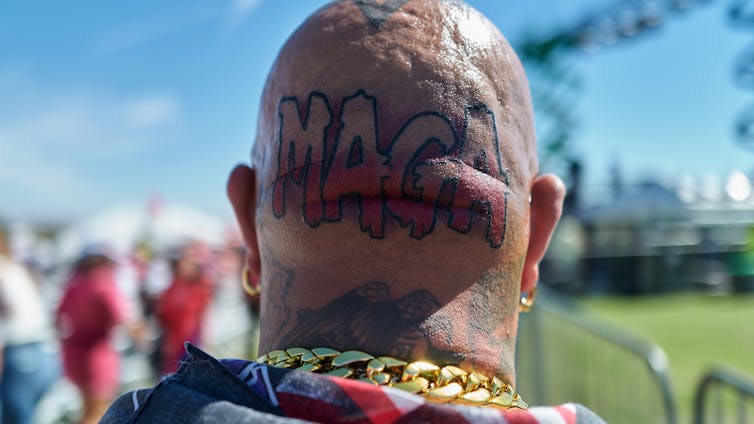 Donald Trump’s Maga supporters often show agressive tendencies against other groups.
EPA/Allison Dinner
Donald Trump’s Maga supporters often show agressive tendencies against other groups.
EPA/Allison Dinner
As a result, they view groups that differ from them as inferior. This justifies any actions that maintain their in-group status.
This holds true even if – as in the case of Maga-followers – it means a belief in violence in response to unwelcome social and cultural changes. Polling has found that Maga supporters are also far more likely to believe that there will be a civil war in the US and that violence in order to advance the movement’s political objectives would be justified.
4. Aggressive followership
There’s a scientific debate about what draws people to authoritarian leaders. Some scholars emphasise the tendency to want to submit to authority, high levels of aggression when sanctioned and adherence to conventional values such as traditional views on religion and sexuality. Others focus more on a preference for conformity over personal autonomy.
But they agree on one point: authoritarian followers submit to leaders who stress the superiority of their social group and who they consider to be capable of handling the threats they see as coming from other groups.
Research on the Maga movement from 2016 shows that Trump supporters were more likely than other supporters of other Republican party candidates to score high on one facet of authoritarianism: the willingness to resort to aggression towards people seen to go against social norms if encouraged by someone they’ve accepted as an authority figure. But they don’t appear to score as highly on two other facets: submission to established authorities and an adherence to conventional values.
This suggests that authoritarianism among the Maga movement has evolved into a more distinct profile, characterised primarily by a prejudiced aggressiveness towards other social groups.
History tells us that radical political movements tend to pop up when the societal context is perceived as threatening. In this process, some people have personal dispositions that make them more prone to follow authoritarian leaders. So it’s important to take both personality and context into account when trying to understand movements such as Maga.
- Psychology
- US politics
- Donald Trump
- Authoritarianism
- MAGA
- Give me perspective
Events
Jobs
-
 Respect and Safety Project Manager
-
Associate Dean, School of Information Technology and Creative Computing | SAE University College
-
Senior Lecturer, Clinical Psychology
-
University Lecturer in Early Childhood Education
-
Case Specialist, Student Information and Regulatory Reporting
 Respect and Safety Project Manager
 Associate Dean, School of Information Technology and Creative Computing | SAE University College
 Senior Lecturer, Clinical Psychology
 University Lecturer in Early Childhood Education
 Case Specialist, Student Information and Regulatory Reporting
- Editorial Policies
- Community standards
- Republishing guidelines
- Analytics
- Our feeds
- Get newsletter
- Who we are
- Our charter
- Our team
- Partners and funders
- Resource for media
- Contact us
-
-
-
-
Copyright © 2010–2025, The Conversation