
- News
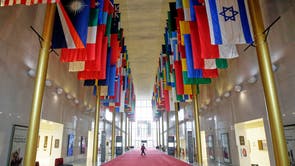
The draw for the 2026 World Cup takes place Friday at the Kennedy Center
Noah TristerWednesday 03 December 2025 15:22 GMTHow does the World Cup draw work? The AP explains FIFA's process for dividing teams into groups
Show all 3


For free real time breaking news alerts sent straight to your inbox sign up to our breaking news emails
Sign up to our free breaking news emails
Sign up to our free breaking news emails
Email*SIGN UPI would like to be emailed about offers, events and updates from The Independent. Read our Privacy notice
The draw for the 2026 World Cup takes place Friday at the Kennedy Center, for the purpose of dividing the 48-team field into 12 groups of four. Once the tournament starts, 32 teams will advance from those preliminary groups to the single-elimination knockout rounds.
The 12 round-robin World Cup groups are designated Group A, Group B ... and so on, down to Group L.
Here’s an explanation of how the draw works.
Picking from pots
Balls corresponding with the competing countries will be separated into four pots of 12, and each group will include one team drawn from each pot. The pots are as follows, with each team's current FIFA ranking in parentheses.
Pot 1 — Spain (1), Argentina (2), France (3), England (4), Brazil (5), Portugal (6), Netherlands (7), Belgium (8), Germany (9), United States (14), Mexico (15), Canada (27).
Pot 2 — Croatia (10), Morocco (11), Colombia (13), Uruguay (16), Switzerland (17), Japan (18), Senegal (19), Iran (20), South Korea (22), Ecuador (23), Austria (24), Australia (26).
Pot 3 — Norway (29), Panama (30), Egypt (34), Algeria (35), Scotland (36), Paraguay (39), Tunisia (40), Ivory Coast (42), Uzbekistan (60), Qatar (51), Saudi Arabia (60), South Africa (61).
Pot 4 — Jordan (66), Cape Verde (68), Ghana (72), Curaçao (82), Haiti (84), New Zealand (86), UEFA Playoff A, UEFA Playoff B, UEFA Playoff C, UEFA Playoff D, FIFA Playoff 1, FIFA Playoff 2.
The host countries — the U.S., Mexico and Canada — are allowed into pot 1. That's a significant perk because it means they avoid being in a group with several of the tournament's top teams. It has already been determined that Mexico will be put in Group A, Canada in Group B and the U.S. in Group D.
Also, the top four teams in the FIFA ranking — Spain, Argentina, France and England — will be drawn in such a way that, should they win their groups, they would not face each other before the semifinals.
Placeholders
Six of the balls in pot 4 do not correspond with any specific country. That's because six spots at the World Cup won't be determined until March. Four European teams will qualify via the UEFA playoffs, and the additional two FIFA playoffs will include teams from all over the world.
The UEFA Playoff A winner will be either Italy, Northern Ireland, Wales or Bosnia-Herzegovina. UEFA Playoff B will be contested by Ukraine, Sweden, Poland and Albania, UEFA Playoff C by Turkey, Romania, Slovakia and Kosovo, and UEFA Playoff D by Denmark, North Macedonia, the Czech Republic and Ireland.
New Caledonia, Jamaica and Congo will compete in FIFA Playoff 1, and Bolivia, Suriname and Iraq in FIFA Playoff 2.
Wait, Italy hasn't qualified yet?
Italy, a four-time World Cup champion, actually hasn't qualified since 2014! But the Italians — currently ranked 12th in the world — still have a shot to make it this time. So teams this week are likely hoping to avoid being drawn into a group with the UEFA Playoff A placeholder.
Additional constraints
The draw will be conducted while keeping some additional requirements in mind:
— Each group must have at least one European team, but no more than two.
— Aside from UEFA (Europe), no two teams from the same confederation can be in the same group. The other confederations are the AFC (Asia) and CAF (Africa), CONCACAF (North and Central America and the Caribbean), CONMEBOL (South America) and the OFC (Oceania).
(In a couple quirks of global soccer, Suriname plays in CONCACAF and Australia plays in the AFC — but New Zealand is part of the OFC.)
Possible groups
Although the pots are largely in descending order of FIFA ranking, there's still plenty of potential variance in how challenging a group might be, especially since pot 4 could yield either a traditional power like Italy or a World Cup newcomer like Curaçao.
Argentina, Morocco, Norway and Italy — if it qualifies — could be a particularly challenging group.
Canada, Austria, South Africa and New Zealand would seem a lot less imposing.
When do we learn the schedule of games?
There is a full reveal of venues and game times set for Saturday, although game dates for the three host countries have already been revealed.
Canada: June 12 (Toronto), June 18 (Vancouver) and June 24 (Vancouver).
Mexico: June 11 (Mexico City), June 18 (Guadalajara) and June 24 (Mexico City).
United States: June 12 (Los Angeles), June 19 (Seattle) and June 25 (Los Angeles).
___
AP soccer: https://apnews.com/hub/soccer