- News
Palestinians in the West Bank are living in fear of more attacks by armed Israeli settlers
Julia FrankelTuesday 02 December 2025 06:07 GMTSettler outposts spread among West Bank villages and fuel fear of more attacks
Show all 5

For free real time breaking news alerts sent straight to your inbox sign up to our breaking news emails
Sign up to our free breaking news emails
Sign up to our free breaking news emails
Email*SIGN UPI would like to be emailed about offers, events and updates from The Independent. Read our Privacy notice
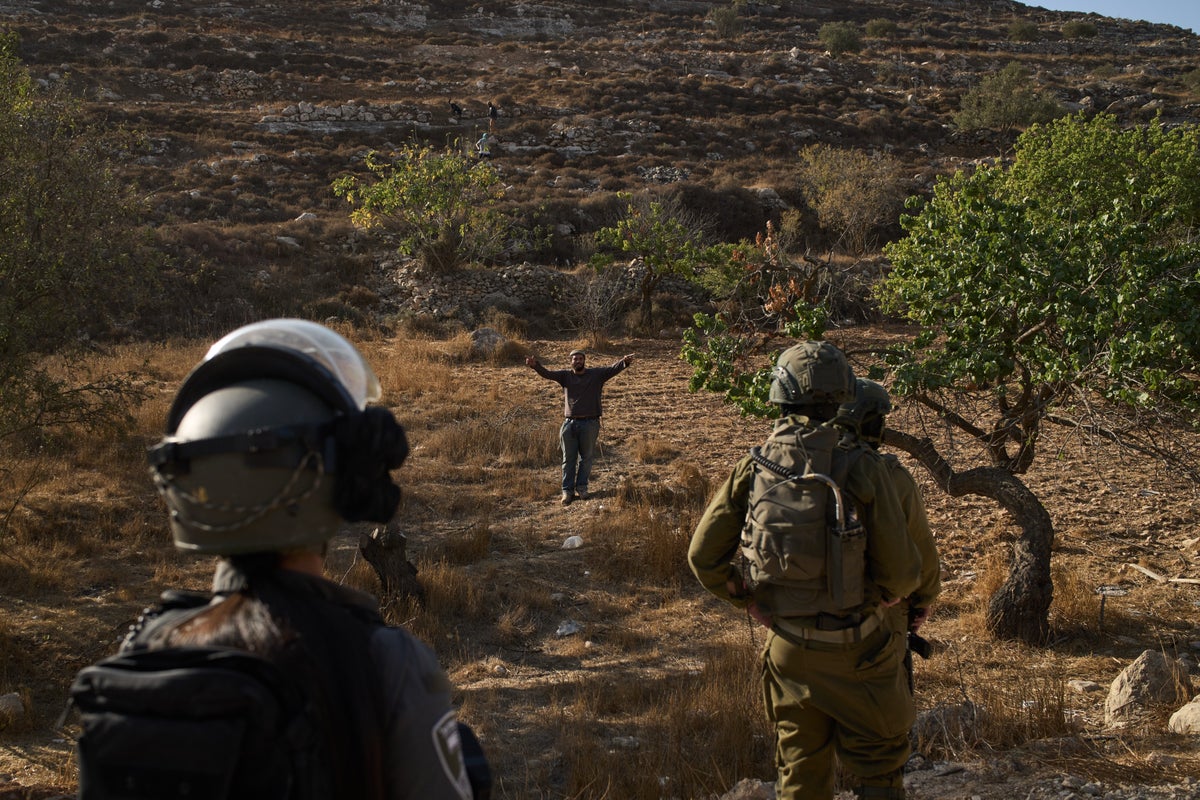
The fear is palpable in this Palestinian village. It’s clear in how farmers gather their harvests quickly, how they scan the valley for movement, how they dare not stray past certain roads. At any time, they say, armed Israeli settlers could descend.
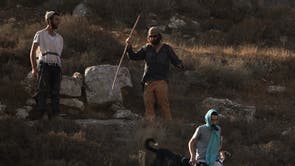
“In a matter of minutes, they get on their phones. They gather themselves, and they surprise you,” said Yasser Alkam, a Palestinian-American lawyer and farmer from the village of Turmus Ayya. “They hide between the trees. They ambush people and beat them up severely.”
In recent months, Alkam says Turmus Ayya has weathered near-daily attacks by settlers, especially after they set up an outpost that the anti-settlement watchdog group Peace Now says is on his village’s land.
Alkam says he can’t reach his own fields for fear of being assaulted. In a particularly gruesome attack, he watched a settler beat a Palestinian grandmother unconscious with a spiky club.
The fear is shared throughout the West Bank. During October's olive harvest, settlers across the territory launched an average of eight attacks daily, according to the United Nations humanitarian office, the most since it began collecting data in 2006. The attacks continued in November, with the U.N. recording at least 136 more by Nov. 24 .
Settlers burned cars, desecrated mosques, ransacked industrial plants and destroyed cropland. Israeli authorities have done little beyond issuing occasional condemnations of the violence.
Prime Minister Benjamin Netanyahu described the attackers as a minority that did not represent most settlers in the West Bank. But their continued expansion of outposts — conducted in public with seemingly few legal repercussions — and the violence have cemented a fearful status quo for their Palestinian neighbors.
A brutal assault on a grandmother
While driving in fields east of Turmus Ayya on Oct. 19, Alkam saw a Palestinian woman named Afaf Abu Alia, a grandmother from a poorer nearby village called Al-Mughayyir. She was harvesting a grove of olive trees that Turmus Ayya villagers loaned to her after the Israeli military bulldozed her own 500 trees earlier this year, she said.
She worked until she began hearing yelling in Hebrew. Settlers descended on the Palestinian road nearby. Suddenly, one ran toward her with a club.
“The monsters started beating me,” she told The Associated Press three weeks after the attack. “After that, my memories get all blurry.”
Video of the attack obtained by the AP shows a settler beating Alia with the jagged club, even after she was motionless. She was hospitalized for four days, requiring 20 stitches to lacerations on her head, she said.
Asked for comment on the attack, the military said its troops and police had “defused” a confrontation in which Israeli civilians were torching vehicles and using physical violence.
In rare move, Israel charges settler responsible
Police arrested a man named Ariel Dahari for beating Abu Alia. An Israeli court charged him later with terrorism.
Dahari is being represented by Honenu, an organization that provides legal aid to settlers. According to an article about Dahari on the group's website, he has received at least 18 administrative orders since 2016 that included house arrest and confinement to his town in Israel.
He told the Israeli news site Arutz Sheva in 2023 that he had been kicked out of the territory twice. It is not clear how he was able to return.
Palestinians and human rights workers say Israeli soldiers and police routinely fail to prosecute attacks by violent settlers. Their sense of impunity has deepened under Israel's far-right National Security Minister Itamar Ben-Gvir, a settler, and Defense Minister Israel Katz, who in January released settlers from administrative detention, Israel’s practice of detaining individuals without charge or trial.
The number of investigations opened into settler violence since 2023, Ben-Gvir's first year in office, has plummeted, according to a report by Israel's Channel 12 TV that cited official police data. Police opened only 60 investigations into settler violence in 2024, compared with 150 cases in 2023 and 235 cases in 2022, the report said.
Investigations rarely result in indictment or conviction. About 94% of all investigation files opened by Israeli police into settler violence from 2005 to 2024 ended without an indictment, according to Israeli rights group Yesh Din. Since 2005, just 3% of those investigations led to convictions.
Dahari told Arutz Sheva that he was determined to stay in the West Bank.
“We will not give up our grip on our land because of one order or another. We will continue to build it and make it flourish everywhere,” he said, adding that he hoped “the security establishment” would “invest all its resources in the war against the Arab enemy, who is the real enemy of us all.”
When reached by the AP, Dahari’s lawyer, Daniel Shimshilashvili, sent a statement from Honenu, saying there was “slim evidence” against Dahari.
Threats are reinforced by settler outposts
The villagers from Turmus Ayya say it's not enough to arrest one settler — the threat of violence is reinforced by the outpost in the nearby valley called Emek Shilo.
Emek Shilo was founded this year on private Palestinian land, according to Peace Now, the anti-settlement monitoring group. It was started by a well-known settler named Amishav Melet, said three Palestinians living in Turmus Ayya and Yair Dvir, the spokesperson for Israeli rights group B'tselem. On his personal X account, Melet posted videos of the outpost’s construction.
Villagers alleged that Melet travels the valley in an all-terrain vehicle, surveilling their activities. He’s frequently armed, they said.
Usually little more than a few sheds and a pen for livestock, such outposts can impose control on nearby land and water sources. They often turn into authorized settlements, spelling the end of Palestinian communities.
Israeli police did not comment when asked about Melet.
Abdel Nasser Awwad had to halt construction of a new family home when the outpost was established. In security camera footage he shared with AP, masked figures showed up at the construction site, smashing his truck with a club and appearing to cut piping. He said they have stoned three of his workers.
When AP visited the village, groups of settlers were visible around the outpost and a settler tractor patrolled the area. Drones hummed in the air.
Melet was convicted of assaulting police in 2014, according to court records. In an interview with Israel's Ynet news in 2015, Melet said he had received administrative orders barring him from the West Bank.
In response to questions from the AP, Melet said he was a “peace activist.”
“Any claim against me that I am active or connected to violence or terrorism or any illegal action is a lie and a falsehood!” he wrote.
He called the AP’s questions “part of a cruel and false campaign” against Zionism that “reeks” of antisemitism.
In video from Oct. 20 shared with the AP by Alkam, a man who Alkam said was Melet was recorded telling a farmer picking olives to leave. The farmer responded, “The army allowed us to be here today.”
“Where is the army?” the man identified as Melet said. “I am the army.”
Palestinians take defense into their own hands
When settlers descend on Turmus Ayya, the mosque emits a loud siren. Young men dash quickly to the village entrance, forming a barrier between their families and the settlers.
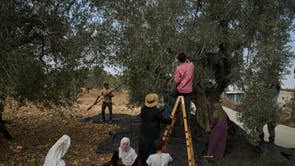
During the harvest, many villagers brought cameras into the fields, hoping footage showing assaults would help hold settlers accountable.
It’s a far cry from past olive harvests, when families spent all day in the groves, picnicking beneath the trees.
Abu Alia, the grandmother, said nothing will prevent her from returning.
“I’ll be back next year.”
