
 Image via Gaga Corporation
 By
Luc Haasbroek
Published 12 minutes ago
Luc Haasbroek is a writer and videographer from Durban, South Africa. He has been writing professionally about pop culture for eight years. Luc's areas of interest are broad: he's just as passionate about psychology and history as he is about movies and TV. He's especially drawn to the places where these topics overlap.
Luc is also an avid producer of video essays and looks forward to expanding his writing career. When not writing, he can be found hiking, playing Dungeons & Dragons, hanging out with his cats, and doing deep dives on whatever topic happens to have captured his interest that week.
Sign in to your Collider account
follow
Follow
followed
Followed
Like
Like
Thread
Log in
Here is a fact-based summary of the story contents:
Try something different:
Show me the facts
Explain it like I’m 5
Give me a lighthearted recap
By
Luc Haasbroek
Published 12 minutes ago
Luc Haasbroek is a writer and videographer from Durban, South Africa. He has been writing professionally about pop culture for eight years. Luc's areas of interest are broad: he's just as passionate about psychology and history as he is about movies and TV. He's especially drawn to the places where these topics overlap.
Luc is also an avid producer of video essays and looks forward to expanding his writing career. When not writing, he can be found hiking, playing Dungeons & Dragons, hanging out with his cats, and doing deep dives on whatever topic happens to have captured his interest that week.
Sign in to your Collider account
follow
Follow
followed
Followed
Like
Like
Thread
Log in
Here is a fact-based summary of the story contents:
Try something different:
Show me the facts
Explain it like I’m 5
Give me a lighthearted recap
Stories about inequality and class divides seem to be gaining popularity, perhaps reflecting increasing real-world anxieties and tensions. Lots of movies that explore these themes can get heavy-handed or simplistic, reducing the issue to its most basic and palatable form. However, the best movies about the class divide are honest and insightful, with a lot to say about dignity, belonging, and the struggle to get by.
With this in mind, this list ranks the very best movies about the class divide. The titles below date back to the early days of cinema and all the way to our modern predicament, ranging from realist drama to dystopian thrillers. They all pack a sharp thematic edge and offer considerable food for thought about an issue that affects everyone, making them all worth seeing.
10 ‘My Fair Lady’ (1964)
 Professor Higgins standing behind Eliza, who's sitting on a chair, in My Fair Lady.Image via Warner Bros. Pictures
"The rain in Spain stays mainly in the plain." My Fair Lady isn't as widely beloved as it once was, but it's still an iconic entry in this particular subgenre. The story follows Eliza Doolittle (Audrey Hepburn), a Cockney flower seller in Edwardian London, who becomes the subject of a bet between linguist Henry Higgins (Rex Harrison) and his colleague. Higgins believes he can train her to speak like a duchess and pass her off in high society.
At first glance, it all seems like a sparkling musical fantasy full of witty banter, elegant gowns, and playful romance. But beneath the charm lies a sharp examination of class and language as tools of exclusion. What begins as a social experiment turns into a commentary on who gets deemed worthy of respect. The movie has a lot to say about how accent, posture, and polish can either sneak you past society's gatekeepers or keep you locked out forever. Eliza learns refinement, but she also recognizes the hollowness of the aristocratic world.
9 ‘The Pursuit of Happyness’ (2006)
 Will and Jaden Smith riding the bus and smiling in The Pursuit of Happyness.Image via Sony Pictures Releasing
"Don’t ever let somebody tell you you can’t do something." Based on the true story of Chris Gardner, The Pursuit of Happyness centers on a struggling salesman (Will Smith) in 1980s San Francisco who becomes homeless while trying to build a better future for his son. He fights for jobs, relying on shelters and sheer grit, all while trying to protect his child from the reality of the situation. Smith’s Oscar-nominated performance brings home the emotional toll of poverty: we feel the scramble to maintain dignity, the quiet panic of not knowing where you’ll sleep, the balancing act between love and survival.
Most modern movies of this kind revel in cynicism, but The Pursuit of Happyness leans into resilience and aspiration, showing how the American dream can be both lifeline and pressure cooker. It acknowledges hardship without romanticizing it, suggesting that class mobility is possible, but brutally rare, and never guaranteed.
8 ‘Sorry We Missed You’ (2019)
 Image via Entertainment One
"I’m a worker… not a slave." Ken Loach's modern tragedy follows a working-class family in Newcastle navigating the brutal realities of the gig economy. Ricky (Kris Hitchen), desperate for stability, takes a job as a delivery driver with crushing hours, no benefits, and endless financial penalties disguised as "freedom." Meanwhile, his wife Abby (Debbie Honeywood) works exhausting shifts as a home-care nurse, and together they try to hold their household together while debt and fatigue encircle them.
The plot isn’t driven by dramatic twists but by accumulation. Small humiliations and impossible choices slowly erode the couple's dignity. As always, Loach takes an incredibly naturalistic and realist approach. The characters feel real, and their struggles feel authentic. All these elements add to the impact, taking Sorry We Missed You beyond typical drama and making it into a social statement. It reflects the actual day-to-day life for millions of people. For many people, this movie is far from fiction; it's reality on the screen.
7 ‘Snowpiercer’ (2013)
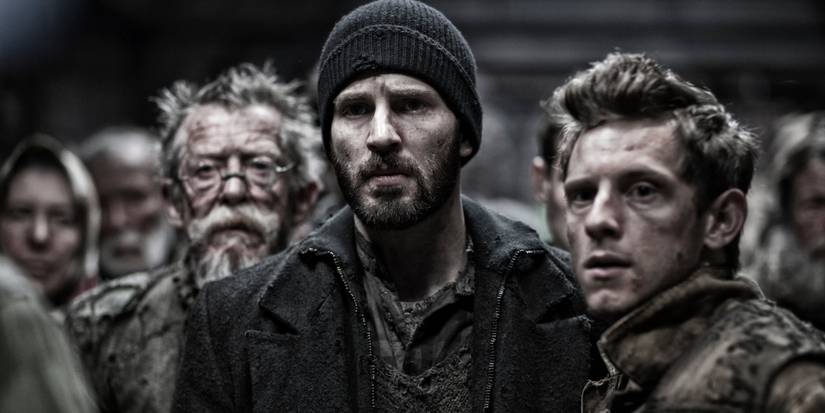 Chris Evans and John Hurt in a crowd looking ahead and feeling anxious in Snowpiercer.Image via Radius TWC
"I know what people taste like. I know that babies taste best." Where Sorry We Missed You leans into realism, Snowpiercer uses sci-fi elements to deliver its class commentary. This dystopian thriller literalizes social hierarchy by placing humanity on a single freezing train: the elites lounge in luxury in the front cars while the poor rot in the tail section. When weary leader Curtis (Chris Evans) sparks a rebellion, the plot becomes a physical ascent through car after car. Each new compartment reveals another absurd flourish of wealth, privilege, or indoctrination.
The movie is action-packed and entertaining, with plenty of colorful characters (Tilda Swinton in particular), but beneath the violence and intrigue lies a bleak truth: revolutions can become mirrors of the systems they overthrow. Every step forward is paid in blood, and each revelation about how the train functions deepens the film’s political despair. It adds up to a furious, claustrophobic metaphor for inequality.
6 ‘Shoplifters’ (2018)
 The family in Shoplifters jumping together and holding hands at the beachImage via Gaga Corporation
"Sometimes, it’s better to choose your family." This quietly devastating movie focuses on a makeshift family living on the margins in Tokyo, surviving through petty theft and shared tenderness. When they take in a neglected young girl (Miyu Sasaki) from an abusive home, their fragile ecosystem becomes both richer in love and riskier under the law. The plot unfolds with gentle rhythms, comprising meals shared, secrets whispered, and bonds formed through necessity. But as authorities question their legitimacy, Shoplifters reveals how social labels and legal definitions often fail to recognize genuine care.
This Japanese masterpiece argues that the poor often create a deeper family than those with abundance. Yet it doesn't exaggerate that point or aim for a contrived feel-good message. The tragedy isn't melodramatic or in your face. Instead, it comes through in the characters' quiet hunger, the cramped spaces they inhabit, and the work that never pays them enough.
5 ‘The Rules of the Game’ (1939)
 A group of soldiers walking through an open fieldImage via Gaumont Film Company
"The awful thing about life is this: everyone has their reasons." The Rules of the Game is a portrait of French high society on the eve of World War II, following aristocrats and their servants during a country-estate hunting weekend. We witness flirtations, jealousies, petty scandals, and shifting alliances, trivial dramas that mask a society unable to grasp its own moral decay.
The upstairs-downstairs structure reveals a social order so entrenched that even rebellion feels choreographed. Everyone plays their expected role, and even the servants mimic the vices of their employers. Here, the ruling class dances toward oblivion while the world outside prepares to burn. The Rules of the Game is subtle but searing, widely considered one of the greatest of all time. It's been cited as an influence by everyone from Robert Altman and Mike Leigh to Paul Schrader, Satyajit Ray, and Martin Scorsese.
4 ‘Parasite’ (2019)
"Rich people are naive. No resentments. No creases on them." Bong Joon Ho strikes again. Parasite begins as a sly comedy about the resourceful Kim family infiltrating the wealthy Park household through fake credentials and clever manipulation. As they secure jobs as a tutor, an art therapist, a driver, and a housekeeper, the film revels in upstairs-downstairs tension. Yet beneath the humor, there's a simmering resentment, and when secrets buried within the Park home surface, the story erupts into violence. This narrative turn feels both shocking and inevitable.
Bong shows inequality not as conflict between good and evil, but between people trapped in different gravitational pulls. The Parks are polite yet insulated; the Kims are ambitious yet desperate. He paints neither side as purely good or purely bad. The movie's true target is the system they live in, the architecture (literally) that defines their lives. This message resonated the world over, and Parasite was an unexpected success.
3 ‘The Grapes of Wrath’ (1940)
 Henry Fonda as Tom Joad and Jane Darwell as Ma in The Grapes of WrathImage via 20th Century Studios
"We’ll go on forever, Pa. Because we’re the people." One of the most famous tales of economic desperation. Set during the Great Depression, John Ford’s adaptation of Steinbeck’s novel follows the Joad family as they flee the Dust Bowl and travel to California seeking work, dignity, and stability. Tom Joad (Henry Fonda), newly paroled, becomes our guide through a landscape where hope wilts under corporate power and migrant labor exploitation. Camps offer temporary relief, but systemic injustice is inescapable. Here, poverty is portrayed not as personal failure but as structural oppression, even violence.
The film balances documentary-like realism with emotional grandeur. It's a story of hungry children, exhausted parents, and small acts of kindness glowing in bleak circumstances. Courage here is quiet: sharing bread, speaking truth, refusing to surrender humanity. All in all, The Grapes of Wrath is honest and grim, yet still fundamentally hopeful about human nature.
2 ‘Metropolis’ (1927)
 Image via Parufamet
"The mediator between head and hands must be the heart." Fritz Lang’s silent epic imagines a futuristic city divided between gleaming skyscrapers and the underground machinery that sustains them, operated by oppressed workers who never see sunlight. When Freder (Gustav Fröhlich), the son of the city’s ruler (Alfred Abel), discovers the suffering below, he becomes entwined with Maria (Brigitte Helm), a working-class leader preaching unity. From here, the plot spirals into revolt, sabotage, and eerie technological prophecy as a robotic double incites chaos.
Metropolis visualizes class as architecture and industry: towering monuments above, grinding labor beneath. Almost a century later, its imagery remains iconic, including endless elevators, mechanical rhythms, and crowds moving like great gears. It's a classic of German Expressionism. Through all this, the movie warns that progress built on exploitation breeds ruin. The only remedy is reconciliation between the head and hands, with the heart as mediator.
1 ‘Bicycle Thieves’ (1948)
 Image via Ente Nazionale Industrie Cinematografiche
"There’s a cure for everything… except poverty." Vittorio De Sica’s neorealist landmark follows Antonio (Lamberto Maggiorani), an unemployed man in post-war Rome, who finally lands a job... only to have his bicycle stolen on the first day. He and his young son Bruno (Enzo Staiola) roam the city searching for the bike, confronting indifference, bureaucracy, and moral temptation along the way. In telling their story, the film moves gently but cuts deeply, showing how poverty strips away options until small losses become catastrophes.
Each disappointment chips at Antonio’s pride, and Bruno witnesses adulthood’s fragility in real time. What makes the film timeless is its refusal to sensationalize this suffering; it simply watches. Class here isn't an abstract idea either. It's the hunger the characters feel and the humiliation they endure. And yet love persists anyway. The final scene, father and son walking hand in hand into uncertainty, is deeply moving.
 Bicycle Thieves
Not Rated
Drama
Release Date
December 13, 1949
Cast
Lamberto Maggiorani, Enzo Staiola, Lianella Carell, Elena Altieri, Gino Saltamerenda, Giulio Chiari, Vittorio Antonucci, Michele Sakara
Runtime
89 Minutes
Director
Vittorio De Sica
Writers
Cesare Zavattini, Luigi Bartolini, Oreste Biancoli, Suso Cecchi d'Amico, Vittorio De Sica, Adolfo Franci, Gherardo Gherardi, Gerardo Guerrieri
Genres
Drama
Powered by
Bicycle Thieves
Not Rated
Drama
Release Date
December 13, 1949
Cast
Lamberto Maggiorani, Enzo Staiola, Lianella Carell, Elena Altieri, Gino Saltamerenda, Giulio Chiari, Vittorio Antonucci, Michele Sakara
Runtime
89 Minutes
Director
Vittorio De Sica
Writers
Cesare Zavattini, Luigi Bartolini, Oreste Biancoli, Suso Cecchi d'Amico, Vittorio De Sica, Adolfo Franci, Gherardo Gherardi, Gerardo Guerrieri
Genres
Drama
Powered by
 Expand
Collapse
Expand
Collapse
-
 Movie
Movie
-
 Shoplifters
-
 Parasite
We want to hear from you! Share your opinions in the thread below and remember to keep it respectful.
Be the first to post Images Attachment(s) Please respect our community guidelines. No links, inappropriate language, or spam.Your comment has not been saved
Send confirmation emailThis thread is open for discussion.
Be the first to post your thoughts.
- Terms
- Privacy
- Feedback
 Mar 11, 2025
The 10 Worst Movies That Tried To Be Social Commentary, Ranked
 3 days ago
The 11 Greatest Movies of the Last 40 Years, Ranked
 Nov 22, 2025
10 Thrilling Movies Where Everybody Dies
 3 days ago
The 10 Greatest Noir Movies, According to Letterboxd
More from our brands

50 Best New Movies on Streaming to Watch Right Now
The Best Movies in Theaters Right Now
17 Best Christmas Movies to Put On After the Kids Go to Bed

Movies To Watch If You Like 365 Days


30 Best Movies About Cheating & Infidelity

The 60 Best Movies Of All Time


The 55 Best Movies of All Time, Ranked
What To Watch
 July 20, 2025
The 72 Best Movies on Netflix Right Now
Trending Now
July 20, 2025
The 72 Best Movies on Netflix Right Now
Trending Now
 Dwayne Johnson's Christmas Movie Flop With 2 Marvel Stars Finds Global Streaming Success
 Channing Tatum's New True Crime Comedy Is an Instant Success
 The 8 Most Shocking TV Show Cancellations (#1 Was at Peak Popularity)